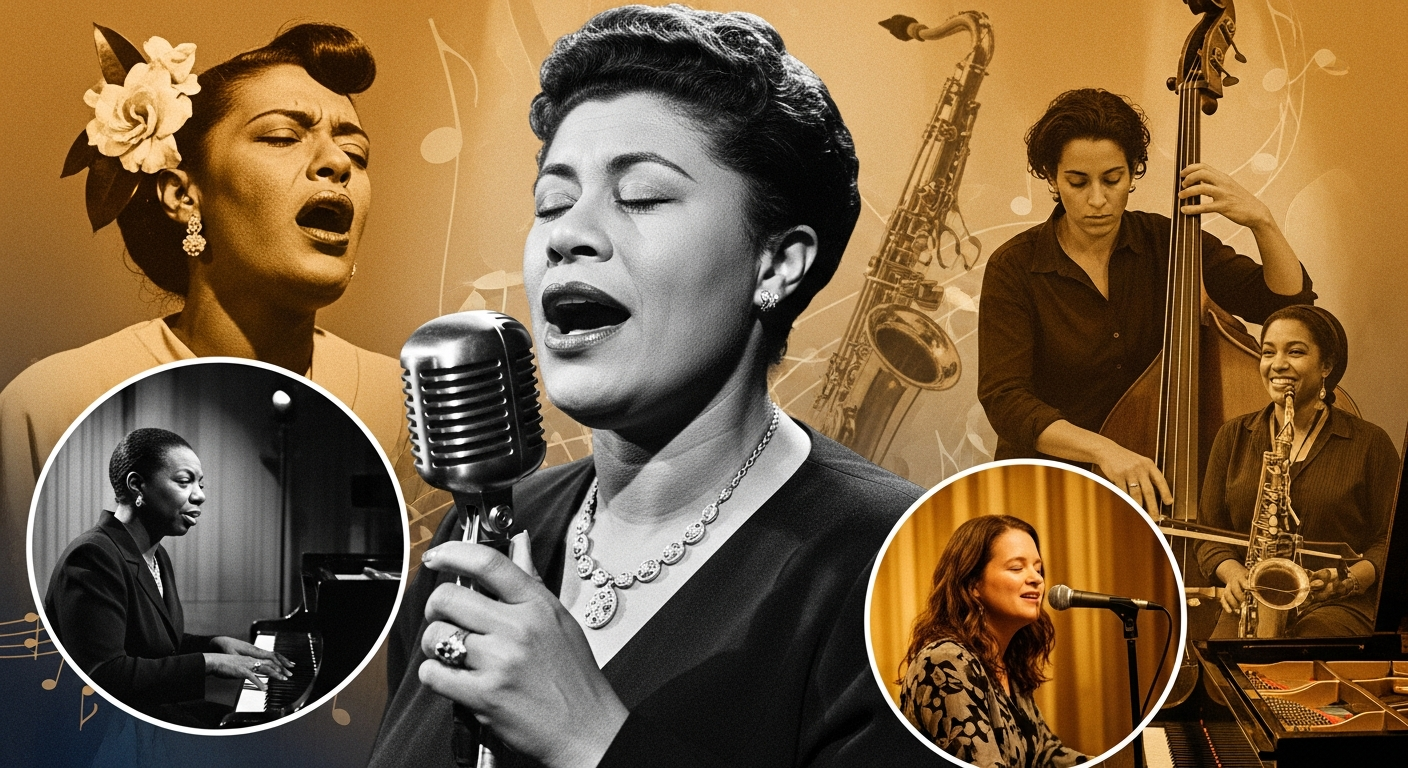
The history of jazz is often told as a history of men — Parker, Coltrane, Davis, Monk, Ellington. But women have been integral to jazz from its earliest days, not just as vocalists but as instrumentalists, composers, arrangers, bandleaders, and innovators. They built the music, and they continue to push it forward. Here are 30 women who shaped jazz.
The Foundational Vocalists
1. Billie Holiday (1915–1959)
Holiday did not have the range of Fitzgerald or the power of Vaughan, but she had something neither could match: the ability to make every song sound like autobiography. Her behind-the-beat phrasing, her bruised emotional vulnerability, and her impeccable song interpretation made her one of the greatest artists in American music. 'Strange Fruit,' her 1939 anti-lynching protest song, remains one of the most powerful recordings ever made.
2. Ella Fitzgerald (1917–1996)
The First Lady of Song. Fitzgerald's vocal range, rhythmic precision, and scat singing ability were superhuman. Her 'Songbook' recordings — eight albums interpreting the work of America's greatest composers — are the definitive versions of those songs. Her 1960 Berlin concert, where her extended scat improvisation on 'How High the Moon' left the audience in awe, is the greatest vocal jazz performance ever recorded.
3. Sarah Vaughan (1924–1990)
If Ella was the technician and Billie was the poet, Sarah Vaughan was the musician. Her rich, operatic contralto, her harmonic sophistication, and her jazz musician's approach to melody made her the favourite vocalist of jazz instrumentalists. Dizzy Gillespie called her 'the greatest singing talent in the universe.'
4. Nina Simone (1933–2003)
Simone was classically trained and brought a pianist's sophistication and a revolutionary's fire to jazz. Her music defies categorisation — jazz, classical, blues, gospel, folk, and protest music all coexist in her work. 'Feeling Good,' 'I Put a Spell on You,' and 'Mississippi Goddam' are among the most powerful recordings in American music.
5. Dinah Washington (1924–1963)
Known as the 'Queen of the Blues,' Washington was equally at home in jazz, blues, and R&B. Her crystal-clear diction, impeccable timing, and emotional directness influenced every female vocalist who followed.
6. Betty Carter (1929–1998)
The most adventurous jazz vocalist of the post-bop era. Carter's rhythmic freedom, daring harmonic choices, and refusal to compromise with commercial trends made her a musicians' favourite. She was also a legendary educator, mentoring dozens of young jazz musicians through her bands.
7. Carmen McRae (1920–1994)
McRae's sophisticated, intellectual approach to lyrics made her the thinking person's jazz singer. Her interpretations of Monk's compositions ('Carmen McRae Sings Monk') demonstrated a deep understanding of jazz harmony unusual for a vocalist.
The Pioneering Instrumentalists
8. Mary Lou Williams (1910–1981)
The most important female instrumentalist in jazz history. Williams was a pianist, composer, and arranger who adapted to every era of jazz — from swing to bebop to free jazz — without ever losing her distinctive voice. She mentored Thelonious Monk and Bud Powell, arranged for Duke Ellington and Benny Goodman, and composed a body of work that deserves far more recognition than it has received.
9. Alice Coltrane (1937–2007)
Alice Coltrane replaced McCoy Tyner in John Coltrane's band and went on to create some of the most visionary music in jazz — blending jazz with Indian classical music, spiritual chanting, and harp. Her albums 'Journey in Satchidananda' and 'Ptah, the El Daoud' are transcendent.
10. Melba Liston (1926–1999)
One of the most important arrangers in jazz history. Liston wrote arrangements for Dizzy Gillespie, Quincy Jones, and Randy Weston that are still performed today. She was also a virtuoso trombonist — one of the few women to play a brass instrument professionally in the mid-20th century.
11. Shirley Horn (1934–2005)
A pianist and vocalist of extraordinary subtlety. Horn's tempo was glacial, her touch was whisper-soft, and her emotional impact was devastating. Miles Davis was a devoted fan.
12. Toshiko Akiyoshi (b. 1929)
The first Japanese woman to gain international recognition in jazz. Akiyoshi is a formidable pianist and one of the greatest big band arrangers/composers in jazz history. Her Toshiko Akiyoshi–Lew Tabackin Big Band produced some of the finest large-ensemble jazz of the 1970s and 80s.
The Modern Era
13. Esperanza Spalding (b. 1984)
Bassist, vocalist, and composer. Spalding won the Grammy for Best New Artist in 2011 — the first jazz artist to win the award, beating Justin Bieber. Her music blends jazz with Brazilian, classical, and R&B influences, and her virtuosity on upright bass is formidable.
14. Cécile McLorin Salvant (b. 1989)
Widely considered the finest jazz vocalist of her generation. Salvant's deep knowledge of jazz history, theatrical stage presence, and extraordinary vocal range (from deep contralto to floating soprano) have earned her multiple Grammys and critical superlatives.
15. Terri Lyne Carrington (b. 1965)
A drummer, composer, and bandleader who has won three Grammy Awards. Carrington was the first woman to win the Grammy for Best Jazz Instrumental Album and is a tireless advocate for gender equity in jazz.
16–20: International Voices
- Nubya Garcia (b. 1991): London-based saxophonist leading the UK jazz renaissance
- Samara Joy (b. 2000): 2023 Grammy Best New Artist — the new voice of classic jazz vocals
- Hiromi Uehara (b. 1979): Explosive Japanese pianist blending jazz, classical, and progressive rock
- Maria Schneider (b. 1960): The most acclaimed jazz composer-arranger of the 21st century
- Yazz Ahmed (b. 1983): British-Bahraini trumpeter fusing jazz with Middle Eastern music
21–25: Vocal Innovators
- Cassandra Wilson (b. 1955): Reimagined jazz vocal tradition with blues, folk, and world music influences
- Dianne Reeves (b. 1956): Five-time Grammy winner with a voice of stunning warmth and power
- Diana Krall (b. 1964): The best-selling female jazz artist of all time, with elegant piano and vocals
- Dee Dee Bridgewater (b. 1950): Grammy and Tony Award winner, passionate advocate for jazz in Africa
- Norah Jones (b. 1979): Crossed jazz into the mainstream with 27 million copies of 'Come Away with Me'
26–30: The Next Generation
- Lakecia Benjamin (b. 1987): Alto saxophonist channelling Coltrane with contemporary energy
- Artemis: All-female supergroup featuring Renee Rosnes, Anat Cohen, and Ingrid Jensen
- Jazzmeia Horn (b. 1991): Thelonious Monk Competition winner with a commanding vocal presence
- Brandee Younger (b. 1983): Harpist continuing Alice Coltrane's legacy in contemporary jazz
- Endea Owens (b. 1994): Bassist from Jazz at Lincoln Center Orchestra, rising star of modern jazz
Why This Matters
Recognising women in jazz is not about filling a quota — it is about telling the complete story of the music. Mary Lou Williams shaped bebop as much as any man. Alice Coltrane's spiritual jazz is as visionary as her husband's. Esperanza Spalding and Cécile McLorin Salvant are not 'great female musicians' — they are great musicians, full stop. The genre's future depends on hearing all of its voices.