You have decided to learn jazz. Now you face the question that has launched a thousand forum arguments: piano or guitar? Both instruments are central to jazz. Both can comp chords, play melodies, and take solos. Both have produced legends who defined the art form. But they are fundamentally different instruments that suit different temperaments, lifestyles, and musical goals.
This guide compares jazz piano and jazz guitar honestly — no instrument snobbery, just practical information to help you choose.
The Physical Instruments
Piano
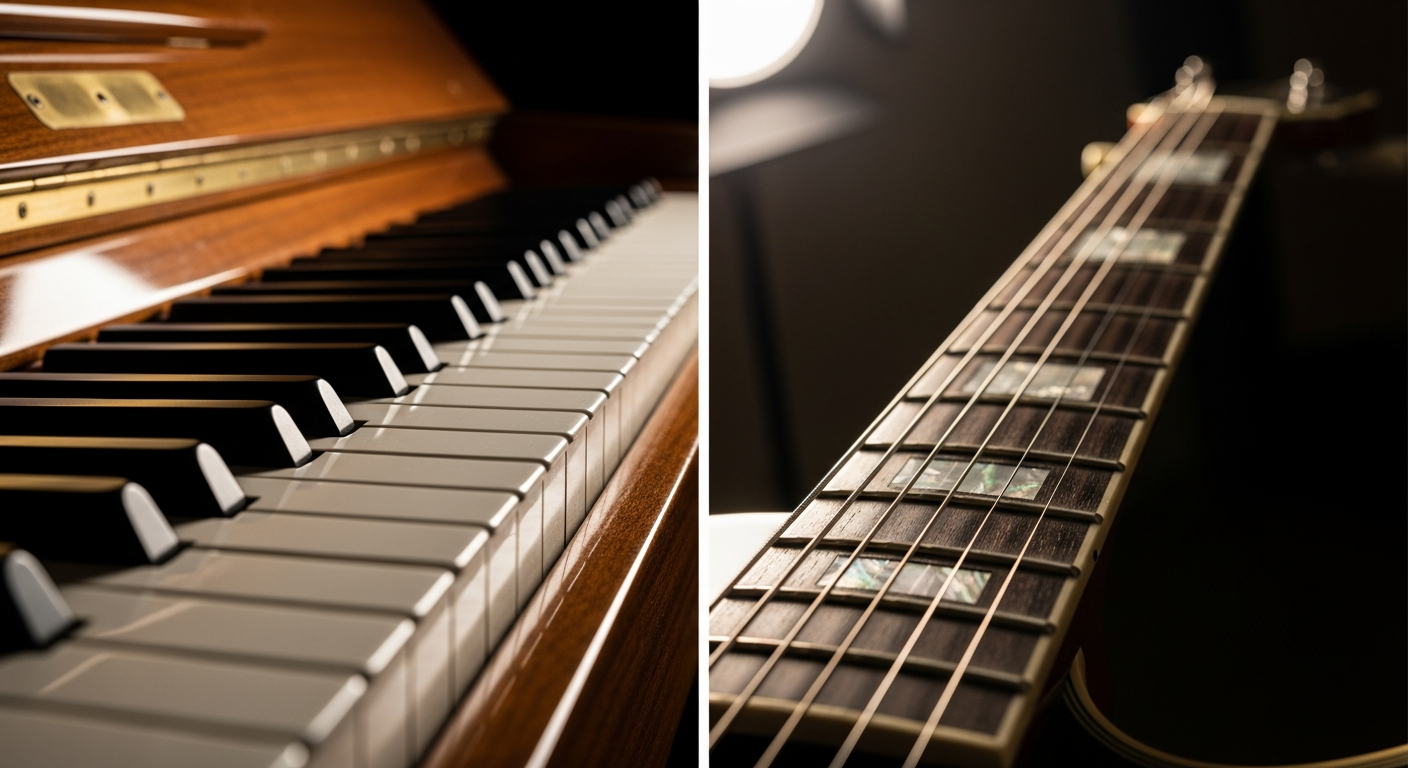
The piano has 88 keys arranged in a linear sequence from low to high. Every note exists in exactly one place. This makes the instrument visually logical — intervals, chords, and scales are spatially consistent. A whole step is always two keys apart. A major chord always has the same shape. This visual clarity is the piano's greatest advantage for learning theory.
The trade-off: piano is not portable (unless you use a digital keyboard), pianos are expensive, and you need two hands doing different things simultaneously — the left hand comps chords while the right hand plays melody or solo lines. This coordination takes months to develop.
Guitar
The guitar has six strings tuned in fourths (with one major-third interval), creating a two-dimensional grid of notes. The same note appears in multiple positions on the fretboard. This makes the instrument more complex to visualise than piano, but also means that chord shapes and scale patterns can be moved up and down the neck without changing fingering — a huge advantage for transposition.
The guitar is portable, relatively affordable, and has a faster initial payoff — you can strum recognisable jazz chords within weeks of starting. However, the fretboard's complexity means that advanced harmonic understanding takes longer to develop than on piano.
Harmony and Voicings
This is where the instruments diverge most significantly. A pianist can play up to 10 notes simultaneously (one per finger), creating rich, full voicings with bass notes, inner voices, and melody. A guitarist is limited to six strings (and typically four to five notes in a voicing), but the guitar's tuning creates naturally open voicings with wide intervals that can sound beautiful and distinct.
Jazz piano voicings tend to be more harmonically complete — rootless voicings, drop-2 voicings, and upper-structure triads all benefit from the piano's linear layout and the ability to use both hands. Use our Chord Voicing Reference to see how different chord types are voiced on a piano keyboard.
Jazz guitar voicings are more constrained but have their own beauty. Drop-2 voicings on guitar sound rich and resonant. The guitar's ability to sustain notes and add vibrato gives chords a living, breathing quality that piano chords lack.
Comping
In a jazz ensemble, both piano and guitar 'comp' — play chordal accompaniment behind soloists. But they comp differently:
- Piano comping is rhythmically diverse and harmonically rich. The pianist can voice full chords with extensions, change voicings beat by beat, and interact rhythmically with the drummer. Piano comping fills more sonic space.
- Guitar comping is more rhythmic and textural. The guitarist plays shorter, punchier chord stabs (Freddie Green style) or sparse voicings that blend into the ensemble. Guitar comping fills less sonic space, which can be an advantage — it leaves more room for the soloist and bass player.
In ensembles with both piano and guitar, the two instruments must be careful not to clash — they occupy similar harmonic territory. Most mixed ensembles work best when one instrument lays back while the other comps actively.
Solo Playing
Piano is the superior solo instrument in jazz. A solo pianist can provide melody, harmony, bass lines, and rhythm simultaneously — a complete musical performance without any other musicians. Solo piano jazz has a rich tradition (Art Tatum, Keith Jarrett, Brad Mehldau) and is a viable performance format.
Solo jazz guitar works in a more limited way — chord-melody arrangements (playing melody and harmony simultaneously) are beautiful but technically demanding and do not provide the full-range sound of a solo piano. Joe Pass and Ted Greene demonstrated the heights of solo jazz guitar, but it remains a specialised skill.
Practical Considerations
- Portability: Guitar wins decisively. You can bring a guitar to a jam session, a friend's house, or a park. Piano requires either a permanent instrument or a digital keyboard with amp.
- Cost: A decent beginner jazz guitar costs $300–600. A decent digital piano costs $500–1,000. An acoustic piano costs $3,000–10,000+.
- Volume: Piano is louder and projects more in an acoustic setting. Guitar often needs amplification in ensemble settings.
- Jam sessions: Both are welcome at jam sessions, but guitarists are more common (easier to bring the instrument). At some jam sessions, the house piano is already there — you just need to show up.
- Theory learning: Piano is the better instrument for understanding jazz theory. The linear layout makes intervals, scales, and chord construction visually intuitive. Many music schools require all students to learn basic piano regardless of their primary instrument.
The Verdict
Choose piano if: you want the deepest possible understanding of jazz harmony, you are interested in solo performance, you want to compose or arrange, or you enjoy the richness of a full-range instrument.
Choose guitar if: portability matters, you want a faster initial payoff, you enjoy the physical intimacy of a handheld instrument, or you are drawn to the guitar's distinctive jazz tone (Wes Montgomery, Pat Metheny, Jim Hall).
Choose both if: you are serious about jazz. Many professional jazz musicians play both instruments at some level. Learning basic piano, even if guitar is your primary instrument, will deepen your harmonic understanding immeasurably.
The most important factor is neither theoretical advantage nor practical convenience — it is which instrument makes you want to practise. The one you pick up every day is the right one.