One hundred years ago, in the small town of Hamlet, North Carolina, a boy was born who would reshape the sound of the twentieth century. John William Coltrane arrived on 23 September 1926, and the ripples of his music continue to expand outward, touching every corner of the jazz world and far beyond.
What Is Coltrane 100?
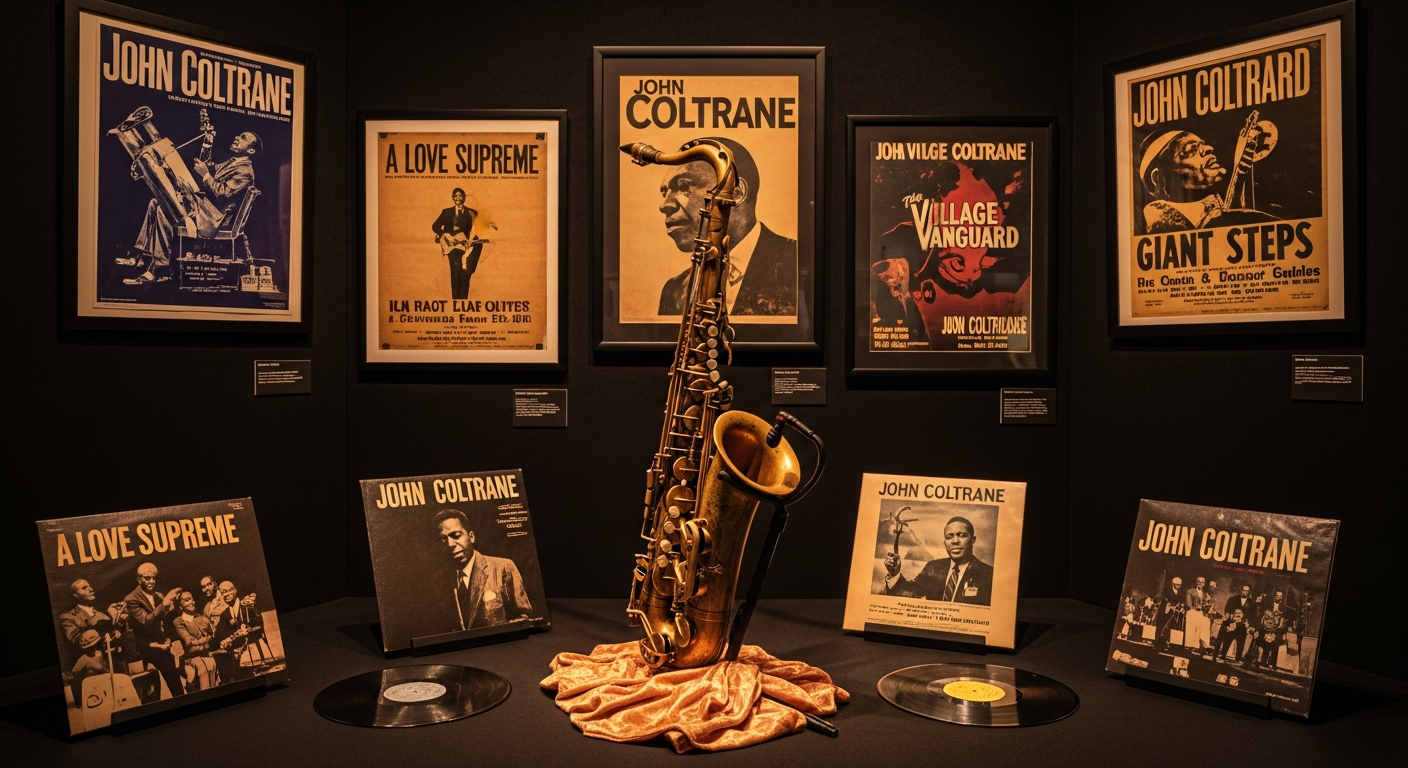
The Coltrane Estate has launched COLTRANE 100, a year-long global celebration that positions Coltrane not merely as a jazz icon but as one of the most significant cultural figures of the modern era. The programme is unprecedented in its scope — coordinating recorded music releases, live tribute performances on every inhabited continent, museum exhibitions, educational initiatives, and partnerships with institutions from the Smithsonian to the United Nations.
"We wanted this centenary to reflect the scale of my grandfather's impact," said Ravi Coltrane, the saxophonist and custodian of the Coltrane legacy. "His music changed how people listen, how musicians play, and how we understand what sound can express. That deserves more than a single concert or a boxed set."
What Are the Tiberi Tapes?
The centenary's most electrifying announcement is the release of the long-mythologised Tiberi Tapes. For decades, rumours circulated among Coltrane scholars and collectors about a set of private live recordings made by musician Frank Tiberi between 1961 and 1965 in jazz clubs across New York and Philadelphia.
The recordings document Coltrane during his most revolutionary period — the years between the commercial breakthrough of "My Favorite Things" and the spiritual summit of "A Love Supreme." They capture performances in intimate club settings where Coltrane was free to experiment, to push his improvisations to extraordinary lengths, to test ideas that would later appear on his landmark studio recordings.
Jamie Krents, President and CEO of UMe and the Verve Label Group, described the significance: "The Tiberi Tapes have literally been the stuff of legend in the world of John Coltrane until now. We're thrilled to finally get to share these recordings of Coltrane's musical evolution with the world."
The tapes will be released via Impulse! Records, with a Record Store Day preview on 18 April 2026 before a wider release in September — timed to coincide with Coltrane's actual centenary date.
What New Coltrane Releases Are Planned for 2026?
Beyond the Tiberi Tapes, the reissue programme is comprehensive. Coltrane's Impulse!, Atlantic, and Prestige catalogues will receive remastered treatments across vinyl, CD, and digital formats throughout the year. Key albums including "A Love Supreme," "Giant Steps," "My Favorite Things," and "Blue Train" are being remastered in Dolby Atmos spatial audio, allowing listeners to experience these recordings in three-dimensional sound for the first time.
"The Essential John Coltrane," a carefully curated compilation spanning his entire career, has already been released as a Target-exclusive 2LP set, introducing Coltrane's music to a new generation of listeners who may discover him through vinyl's continued renaissance.
How Is Jazz Appreciation Month Celebrating Coltrane?
April 2026 marks the 25th anniversary of Jazz Appreciation Month (JAM), created in 2001 by John Edward Hasse at the Smithsonian's National Museum of American History. This year's programming carries special weight, coinciding with both the Coltrane centenary and the 250th anniversary of the United States.
The Smithsonian's April programme includes "Early Jazz on Film" (11 April), featuring rarely seen jazz shorts from the Cohen Film Collection restored in digital 2K resolution. University Band JAM (10 April) brings top collegiate jazz ensembles to the museum. The Smithsonian Jazz Masterworks Orchestra presents "Jazz Across America" (17 April). And Ella Fitzgerald Day (24 April) honours another towering figure in jazz history.
What Is Coltrane's Lasting Legacy?
To understand why Coltrane's centenary has generated this extraordinary response, one must reckon with the scale of his influence. In a career that lasted barely two decades — he died in 1967 at just forty — Coltrane traversed more musical territory than most artists cover in a lifetime.
From the hard bop precision of his early work with Miles Davis and Thelonious Monk, through the harmonic revolution of "Giant Steps," the modal explorations of "My Favorite Things," the spiritual transcendence of "A Love Supreme," and the radical freedom of his late-period work, Coltrane was in a state of constant, restless evolution.
His influence radiates outward through jazz into rock, electronic music, hip-hop, and contemporary classical composition. His concept of "sheets of sound" — rapid, cascading arpeggios that seemed to contain every possible note — anticipated the maximalist aesthetics of both heavy metal and electronic dance music. His spiritual searching inspired musicians across genres and cultures to treat their art as a vehicle for transcendence.
Ian Carr, who was profoundly influenced by Coltrane's example, once wrote that Coltrane showed every musician what total commitment to the art of music looks like. That commitment — the willingness to destroy what you have built in order to build something greater — remains the most powerful lesson any musician can learn.
As the centenary celebrations unfold throughout 2026, from the Smithsonian to village jazz clubs, from Impulse! Records to streaming platforms, one truth becomes increasingly clear: Coltrane's music has not aged. It has not become historical artefact. It remains as challenging, as beautiful, and as necessary as the day it was recorded. At one hundred, Trane is still blowing.