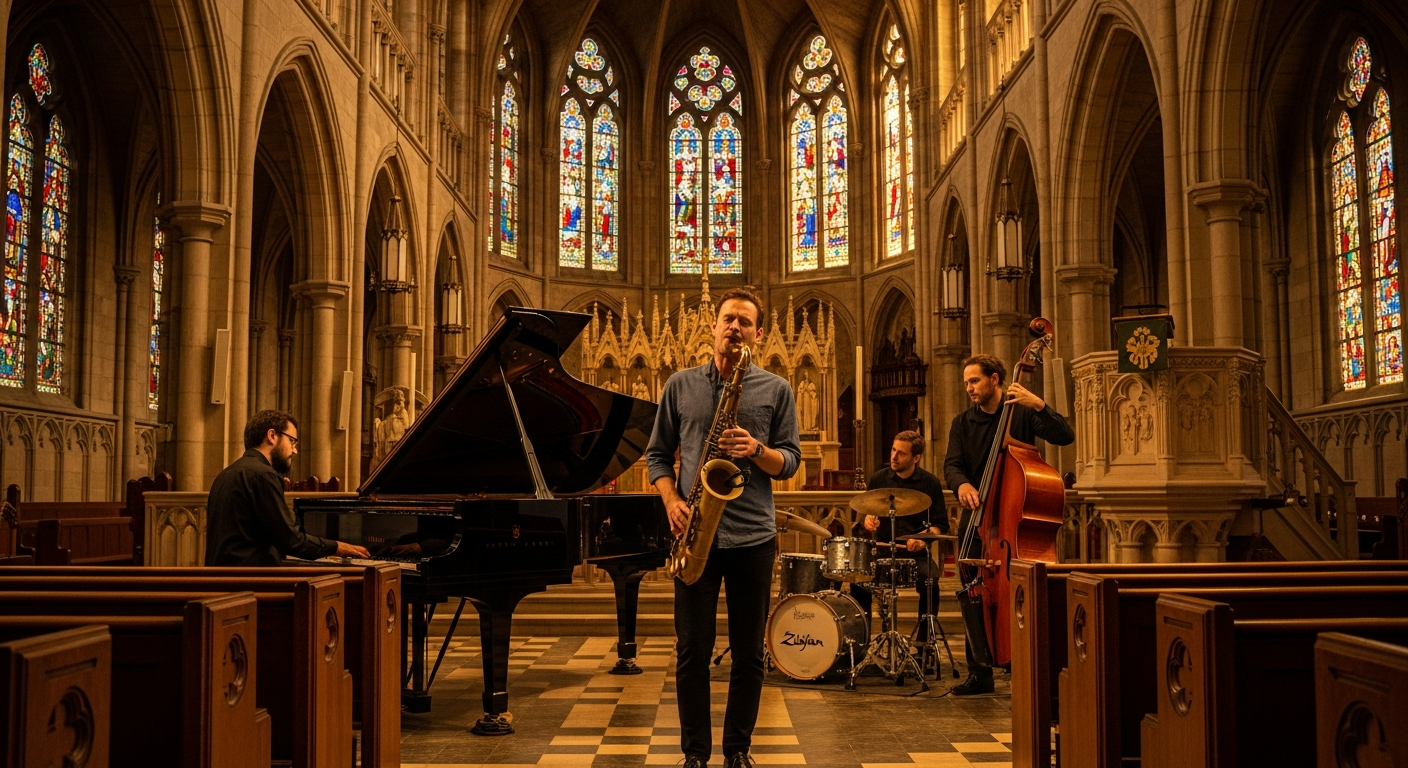
Jazz was born in the church. Long before the first notes sounded in the dance halls of New Orleans, the musical traditions that would become jazz — field hollers, spirituals, hymns, and gospel songs — were forged in African American worship. The blue notes, call-and-response patterns, and emotional intensity that define jazz all trace back to sacred music. It should come as no surprise, then, that many of jazz's greatest artists have been people of deep Christian faith, and that some of the most important works in the jazz canon are explicitly devotional.
This is not a story about musicians who happened to attend church on Sundays. These are artists for whom faith was the animating force of their creative lives — who understood improvisation as a form of prayer, who saw the bandstand as an extension of the altar, and who used their extraordinary gifts to glorify God in music that transcended genre boundaries.
Duke Ellington: 'The Most Important Thing I Have Ever Done'
Edward Kennedy 'Duke' Ellington (1899–1974) is rightly celebrated as one of the greatest composers in American history, jazz or otherwise. What is less widely known is that Ellington was a man of profound personal faith who read the Bible daily, prayed before every performance, and ultimately devoted the final decade of his life to sacred music.
Between 1965 and 1973, Ellington composed and performed three Sacred Concerts — monumental works for jazz orchestra, choir, dancers, and soloists that were performed in cathedrals and churches around the world. The first premiered at Grace Cathedral in San Francisco on 16 September 1965. The second debuted at the Cathedral of St. John the Divine in New York on 19 January 1968. The third was performed at Westminster Abbey in London in October 1973, just seven months before Ellington's death.
'Every man prays in his own language, and there is no language that God does not understand,' Ellington wrote in the programme notes for the first Sacred Concert. He considered these works the most important music he had ever composed — more significant than 'Take the A Train,' more meaningful than the hundreds of masterpieces that had already secured his place in history.
The Sacred Concerts were not universally praised at the time. Some jazz critics dismissed them as sentimental; some churchgoers questioned whether jazz belonged in a cathedral. But Ellington was unbothered. 'I am not concerned with what it is called,' he said. 'I just want it to sound good.' Today, the Sacred Concerts are recognised as visionary works that anticipated the explosion of sacred jazz in the late twentieth century and opened doors that remain wide open.
Mary Lou Williams: From the Bandstand to the Baptismal Font
Mary Lou Williams (1910–1981) — pianist, composer, arranger, and the only major jazz musician to be active across every era from early swing to free jazz — is one of the most remarkable figures in American music history. She arranged for Benny Goodman, Duke Ellington, and Dizzy Gillespie. She mentored Thelonious Monk, Charlie Parker, and Bud Powell. She was, quite simply, indispensable.
In the early 1950s, exhausted by decades of relentless touring and disillusioned by the music industry, Williams withdrew from public performance. She spent several years in spiritual searching before converting to Roman Catholicism in 1957, with the Harlem-based Jesuit priest Father Anthony Woods serving as her mentor. Her conversion was not a retreat from music but a transformation of it.
Williams returned to performing and composing with renewed purpose, channelling her faith into a series of extraordinary sacred works. Her Black Christ of the Andes (1963) was a jazz hymn honouring St. Martin de Porres, the first black saint in the Americas. Her three masses — including Mary Lou's Mass (1970), which was choreographed by Alvin Ailey and performed at St. Patrick's Cathedral in New York — brought jazz into the liturgy with a power and authenticity that no other composer had achieved.
'Jazz is love,' Williams often said. 'You have to live it.' For the last twenty-five years of her life, that love was inseparable from her Catholic faith. She spent her final years teaching at Duke University, where she established a foundation to support musicians struggling with addiction and poverty — a ministry of care that extended her faith beyond the keyboard.
John Coltrane: A Love Supreme
No discussion of faith in jazz can omit John William Coltrane (1926–1967), whose spiritual journey produced what many consider the single greatest recording in jazz history. Coltrane was raised in a devout Christian household in High Point, North Carolina. His maternal grandfather, the Reverend William Blair, was a minister in the African Methodist Episcopal Zion Church, and young John grew up immersed in hymns, spirituals, and scripture.
By the mid-1950s, Coltrane was mired in heroin and alcohol addiction that threatened to destroy both his career and his life. In 1957, he experienced a profound spiritual awakening — a moment he later described as a direct encounter with God. He quit drugs and alcohol, and from that point forward, his music became an explicitly spiritual endeavour.
'During the year 1957, I experienced, by the grace of God, a spiritual awakening which was to lead me to a richer, fuller, more productive life,' Coltrane wrote in the liner notes to A Love Supreme (1964). 'I humbly asked to be given the means and privilege to make others happy through music.'
The resulting album — a four-part suite titled 'Acknowledgement,' 'Resolution,' 'Pursuance,' and 'Psalm' — is a musical prayer of extraordinary intensity and beauty. The final movement, 'Psalm,' is a wordless recitation: Coltrane plays his saxophone in direct correspondence with a poem he had written to God, each melodic phrase matching a line of the text. It is one of the most moving pieces of music ever recorded.
Coltrane's spirituality was ecumenical — he studied Hinduism, Islam, Buddhism, the Kabbalah, and African spiritual traditions alongside Christianity — but his roots remained in the black church. The Saint John Coltrane African Orthodox Church in San Francisco, founded in 1971, canonised him as a patron saint and incorporates his music into weekly worship services to this day.
Oscar Peterson: Church Roots, Concert Halls
Oscar Emmanuel Peterson (1925–2007), the Canadian virtuoso widely regarded as one of the greatest jazz pianists who ever lived, grew up in a household where faith and music were one and the same. His father, Daniel Peterson, a self-taught pianist who had worked as a sailor and porter, was a devout Christian who insisted that all five of his children study music. Oscar began playing piano at age five and was performing in his father's church by the time he was a teenager.
Peterson rarely spoke publicly about his faith in explicit terms, but its influence permeated his music. His album Easter Suite (1984) is a devotional work tracing the story of Christ's crucifixion and resurrection through solo piano. His 1965 recording of 'Hymn to Freedom' — originally composed as a civil rights anthem — became an unofficial hymn of the movement in Canada and beyond, its gospel harmonies and soaring melody reflecting Peterson's deep roots in church music.
'My father taught me that music was a gift from God,' Peterson said in a 1993 interview. 'And you don't waste a gift from God.' That ethic of stewardship — the idea that musical talent carries a sacred obligation — drove Peterson through more than sixty years of performing and two hundred recordings.
Kirk Whalum: The Saxophonist as Minister
If any living musician embodies the unity of jazz and Christian faith, it is Kirk Whalum (born 1958). The Memphis-born tenor saxophonist — who played the iconic solo on Whitney Houston's 'I Will Always Love You' — has spent more than four decades building a career that refuses to separate the sacred from the secular.
Whalum grew up in a musical and religious family; his father was a church pastor, and Kirk began playing in church as a child. After achieving mainstream success in smooth jazz and R&B, he increasingly turned his attention to gospel jazz, releasing albums such as The Gospel According to Jazz (a series spanning multiple volumes from 1998 to 2014) that explicitly set worship music in a jazz context.
In 2002, Whalum was ordained as a minister, and he now serves as a worship leader at his church in Memphis. He views his saxophone playing and his ministry as inseparable. 'I don't compartmentalise,' he has said. 'When I play, I'm worshipping. When I worship, I'm playing. It's all one thing.'
Whalum's The Gospel According to Jazz albums are landmark recordings that brought gospel jazz to a wide audience without diluting either the jazz or the gospel. His collaborations span from George Duke and Larry Carlton to worship artists like CeCe Winans and Donnie McClurkin — a range that reflects his conviction that all music, at its best, is sacred.
Ben Tankard: The Godfather of Gospel Jazz
Ben Tankard (born 1964) has earned the nickname 'the Godfather of Gospel Jazz' through sheer persistence and prolific output. A former professional basketball prospect whose career was ended by injury, Tankard turned to music and built a career that has produced more than twenty albums, multiple Stellar Award nominations, and a reality television series (Thicker Than Water) on the Bravo network.
Tankard's piano style blends smooth jazz, funk, and gospel into a sound that is unmistakably his own. Albums like Full Tank (2011) and Rise (2019) showcase his ability to create sophisticated instrumental music that remains accessible and spiritually grounded. He is also a pastor, and like Whalum, he sees no boundary between his musical and ministerial callings.
Cyrus Chestnut: Hymns at the Heart
Baltimore-born pianist Cyrus Chestnut (born 1963) grew up playing in his father's Baptist church, and the sound of hymns has never left his fingers. Chestnut is a virtuoso in the tradition of Oscar Peterson and Ahmad Jamal — technically dazzling, rhythmically powerful, and deeply swinging — but what sets him apart is the way he weaves sacred melodies into even his most secular performances.
His album Spirit (2009) is a collection of hymns and spirituals rendered with the full harmonic sophistication of modern jazz. Songs like 'It Is Well with My Soul' and 'Blessed Assurance' become extended improvisational journeys that honour the originals while transforming them into something new. Chestnut has said that he considers every performance an act of worship, regardless of the venue.
Les McCann: Soul Jazz and the Spirit
Les McCann (1935–2023), the pianist and vocalist best known for the landmark live album Swiss Movement (1969, with Eddie Harris), was rooted in the gospel tradition from childhood. Born in Lexington, Kentucky, McCann grew up singing in church and never lost the rhythmic intensity and emotional directness of gospel music. His piano style — percussive, funky, and deeply soulful — was a direct extension of the music he heard every Sunday.
McCann rarely made explicitly sacred recordings, but the spirit of the church ran through everything he played. His influence on the soul jazz and jazz-funk movements of the 1960s and 1970s helped bring the energy of black worship music into secular jazz, creating a bridge that later artists like Kirk Whalum and Ben Tankard would cross in the opposite direction.
The Living Tradition
The connection between Christianity and jazz is not a historical curiosity — it is a living, breathing tradition that continues to produce extraordinary music. Contemporary artists like Cory Henry (whose Pentecostal church upbringing fuels his electrifying organ playing), Jonathan Butler (the South African guitarist and vocalist whose albums blend jazz, gospel, and worship), and Tori Kelly (whose Grammy-winning gospel album Inspired by True Events drew on jazz influences) are carrying the tradition forward.
Jazz was born in the church, and the church has never stopped producing jazz. For the artists profiled here, faith was not a limitation or a marketing strategy — it was the source of their deepest creativity, the fire that burned at the centre of their art. As Duke Ellington put it: 'There is no such thing as jazz sacred or jazz secular. It's all one. Music is music.'