Jazz has an intimidation problem. From the outside, it looks like music made by and for experts — complex harmony, unfamiliar rhythms, solos that go on for minutes, and a vocabulary full of words like 'changes,' 'head,' and 'blowing.' Walk into a jazz club for the first time and you might wonder if everyone else received a manual that you missed.
Here is the secret: there is no manual. Jazz fans did not start out understanding everything. They started exactly where you are now — curious, slightly confused, and willing to listen. The difference between a jazz novice and a jazz lover is usually about three albums and a few hours of attention. This guide will give you the path.
Step 1: Start with One Album, Not a Playlist
The biggest mistake new jazz listeners make is putting on a 'Jazz Essentials' playlist and shuffling through random tracks. This is like trying to learn about cinema by watching random scenes from 50 different films. You get fragments, not understanding.
Jazz albums are coherent artistic statements. The musicians chose to record those specific tunes, in that order, with that group. The album tells a story. Listen to it as one.
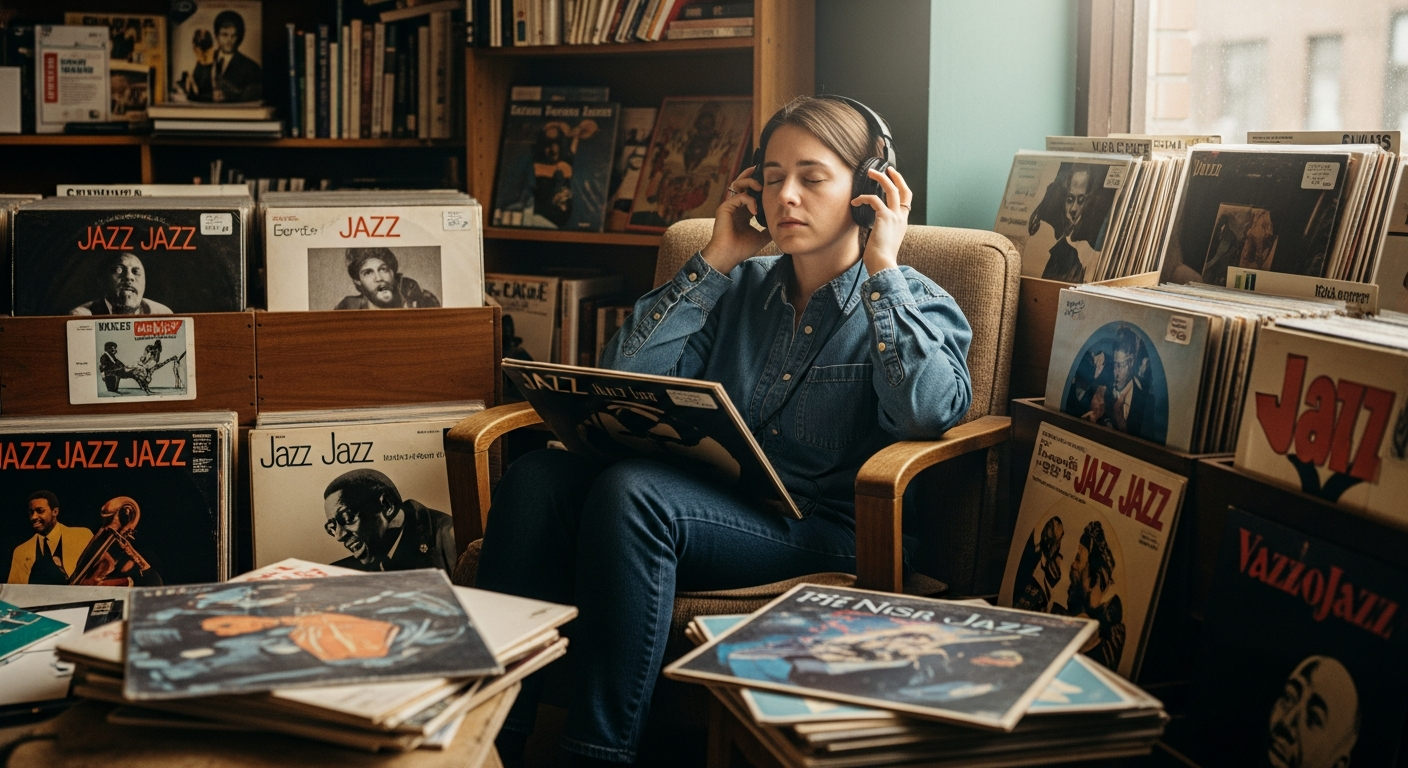
Your first album should be Miles Davis — Kind of Blue (1959). Put it on, start to finish, with decent headphones or speakers. Do not skip tracks. Do not check your phone. Just listen. The album is 46 minutes long. Give it those 46 minutes. If nothing else, you will hear some of the most beautiful music ever recorded.
Step 2: Listen for the Conversation
Jazz is a conversation between musicians. This is the single most important thing to understand. When a saxophone player takes a solo, the drummer is not just keeping time — they are responding. When the soloist plays something rhythmically complex, listen to the drummer react. When the harmony shifts, listen to the pianist adjust their voicings. The magic of jazz is not any one instrument — it is the interaction between all of them.
On your second listen of Kind of Blue, try focusing on one instrument at a time. Listen to the whole album focusing only on Paul Chambers's bass. Then listen again focusing on Jimmy Cobb's drums. You will hear things you missed entirely on the first listen. Jazz reveals new layers every time you return to it.
Step 3: Follow the Musicians
Once you have found an album you love, look at the liner notes (or the streaming credits). Who played on it? Those musicians made other albums — explore them. Jazz is a web of connections, and following the threads is one of the great pleasures of the genre.
From Kind of Blue, the paths branch beautifully:
- John Coltrane (tenor saxophone) → A Love Supreme, My Favorite Things, Blue Train
- Cannonball Adderley (alto saxophone) → Somethin' Else, Mercy, Mercy, Mercy!
- Bill Evans (piano) → Waltz for Debby, Sunday at the Village Vanguard
- Miles Davis (trumpet) → Sketches of Spain, In a Silent Way, Bitches Brew
Each of these albums leads to more musicians, more albums, and more discoveries. Within a month of following these threads, you will have a jazz library that could fill a weekend.
Step 4: Explore Different Eras
Jazz is not one sound. It is a century of evolution, and each era has its own character:
- Swing Era (1930s–40s): Big bands, dancing, infectious energy. Start with Duke Ellington or Count Basie.
- Bebop (1940s–50s): Fast, complex, virtuosic. Start with Charlie Parker's 'Now's the Time' or Dizzy Gillespie's 'A Night in Tunisia.'
- Cool Jazz (1950s): Relaxed, lyrical, understated. Start with Chet Baker or the Modern Jazz Quartet.
- Hard Bop (1950s–60s): Blues-drenched, soulful, energetic. Start with Art Blakey's 'Moanin'' or Horace Silver's 'Song for My Father.'
- Modal Jazz (1959–65): Spacious, meditative, scale-based. Start with Kind of Blue (you already did).
- Free Jazz (1960s–70s): Experimental, boundary-breaking, intense. Save this for later — start with Ornette Coleman's 'The Shape of Jazz to Come' when you are ready.
- Fusion (1970s): Jazz meets rock, funk, and electronics. Start with Herbie Hancock's 'Head Hunters' or Ian Carr's Nucleus — 'Elastic Rock.'
- Contemporary (2000s–now): Everything and anything. Start with Kamasi Washington, Robert Glasper, or Nubya Garcia.
Step 5: Go to a Live Show
Recorded jazz is wonderful. Live jazz is transformative. There is no substitute for being in a room where musicians are creating music in real time, responding to the audience, to each other, and to the moment. A jazz club show — even at a small local venue — will deepen your appreciation more than any playlist or guide.
When you go, do not worry about clapping at the right time (clap after solos — you will hear when they end because the audience around you will applaud) or understanding everything that happens. Just listen, watch the musicians interact, and let the music wash over you. Jazz is meant to be experienced, not studied.
Step 6: Let It Take Time
Some jazz albums click immediately. Others take three or four listens to reveal their beauty. That album that confused you on Monday might become your favourite by Friday. Jazz rewards patience and repeated listening in a way that few other genres do. Do not give up on an album after one listen — give it at least three chances before deciding it is not for you.
The most important thing is to keep listening. Put on a jazz album while you cook dinner, while you drive, while you work. Let it become part of the soundtrack of your daily life. One day, you will realise that you are not just hearing the music — you are following it. You will hear the conversation between the musicians, anticipate the harmonic shifts, and feel the emotional arc of a solo. That is the moment you become a jazz fan. And it is closer than you think.