If someone plays you a blues track and a jazz track back to back, you will instantly hear the difference — even if you cannot articulate what it is. Blues feels earthy, raw, and emotionally direct. Jazz feels complex, sophisticated, and restlessly inventive. Yet the two genres share DNA. They grew from the same soil, the same communities, and the same musical traditions. Understanding what connects them — and what separates them — is understanding the story of American music itself.
Origins: Shared Roots, Different Branches
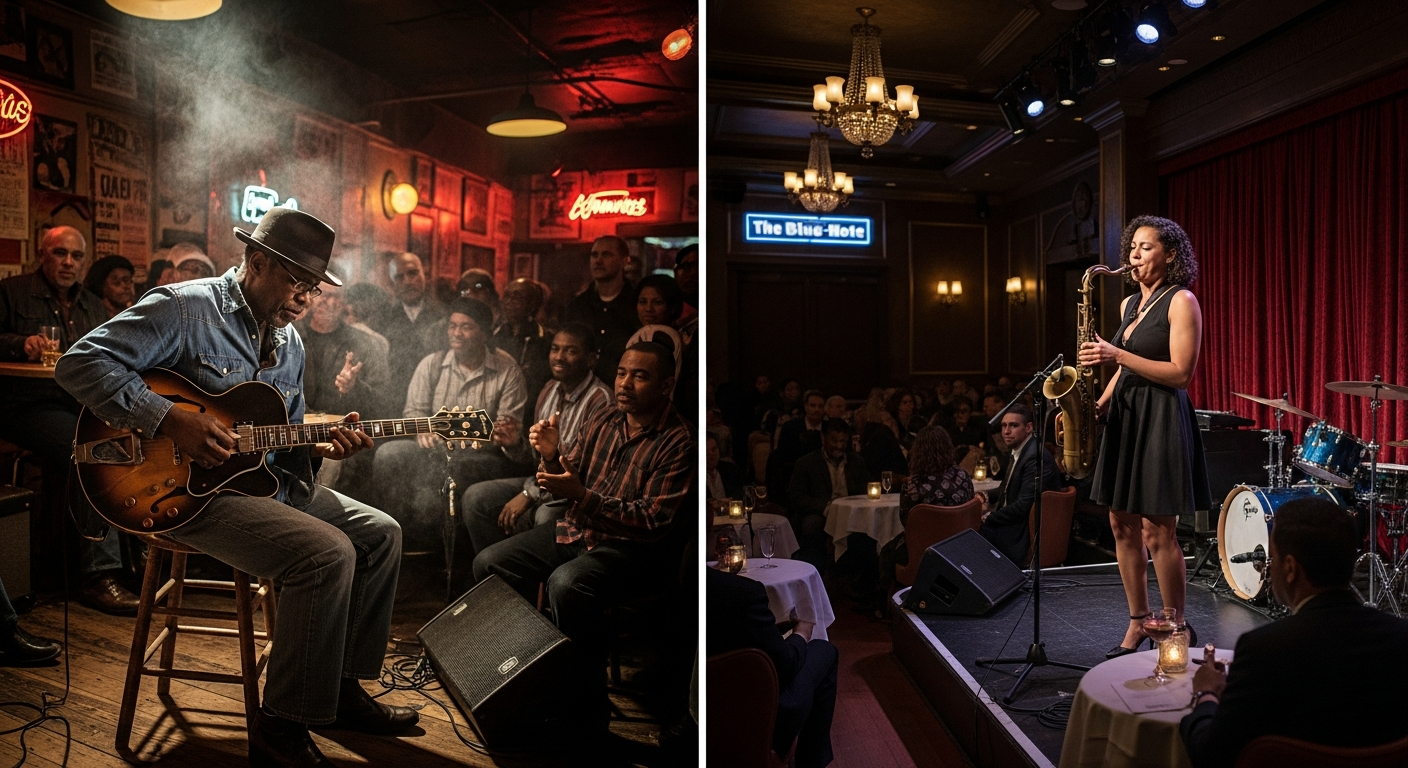
Both jazz and blues emerged from the African American experience in the late 19th and early 20th centuries. Blues grew from the field hollers, work songs, and spirituals of the rural American South — particularly the Mississippi Delta. It was the music of hardship, longing, and resilience, sung by individuals accompanying themselves on guitar or piano.
Jazz emerged in urban centres, most notably New Orleans, where African American musical traditions collided with Creole culture, European harmony, brass band traditions, and ragtime. While blues was largely a solo or small-group folk music, jazz was born as an ensemble art form — collective improvisation over a shared harmonic framework.
The crucial point is that blues did not simply 'become' jazz. Blues is one of the ingredients of jazz, alongside ragtime, marching band music, gospel, and European classical harmony. They are siblings, not parent and child.
Harmony: Three Chords vs. Three Hundred
The most obvious musical difference between blues and jazz is harmonic complexity. A standard 12-bar blues uses three chords — the I, IV, and V — typically played as dominant 7th chords. In the key of A, that gives you A7, D7, and E7. The entire form cycles through these three chords in a fixed 12-bar pattern. That is it. The harmonic simplicity is not a limitation — it is a feature. It leaves space for the melody, the lyrics, and the emotional delivery to carry the music.
Jazz, by contrast, uses extended and altered harmony. A typical jazz chord is not just a triad or a 7th chord — it is a 9th, 11th, or 13th chord, often with alterations (b9, #9, #11, b13). A jazz standard might move through four or five different key centres in 32 bars, using ii-V-I progressions to modulate smoothly between them. Where blues stays in one key and one harmonic world, jazz is constantly travelling.
To explore the richness of jazz harmony, try our Chord Voicing Reference — you will see how many variations exist for each chord type, compared to the basic dominant 7th voicings of the blues.
Scales and Melody
Blues melodies are built primarily from the minor pentatonic and blues scales. The minor pentatonic (1–b3–4–5–b7) and its extension, the blues scale (adding the b5), provide the vocabulary for virtually all blues improvisation. The 'blue notes' — the flatted 3rd, 5th, and 7th — give the music its characteristic soulful sound. Blues musicians bend these notes, slide between them, and use them to express emotion in ways that transcend the written note.
Jazz musicians use a much wider palette of scales. Over a single chord, a jazz improviser might choose from Dorian, Mixolydian, Altered, Lydian, Bebop, Whole Tone, or Diminished scales, depending on the harmonic context and the level of tension desired. Our Scale Finder shows the full range of scales available for each chord type — the contrast with blues, where one or two scales cover everything, is striking.
Rhythm and Feel
Blues rhythm is typically straight and groove-based. Most blues tunes use a shuffle feel (a triplet-based rhythm that creates a rolling, rocking sensation) or a straight-eighth rock/funk groove. The rhythm section locks into a groove and stays there, providing a steady foundation for the singer or soloist to ride on top of.
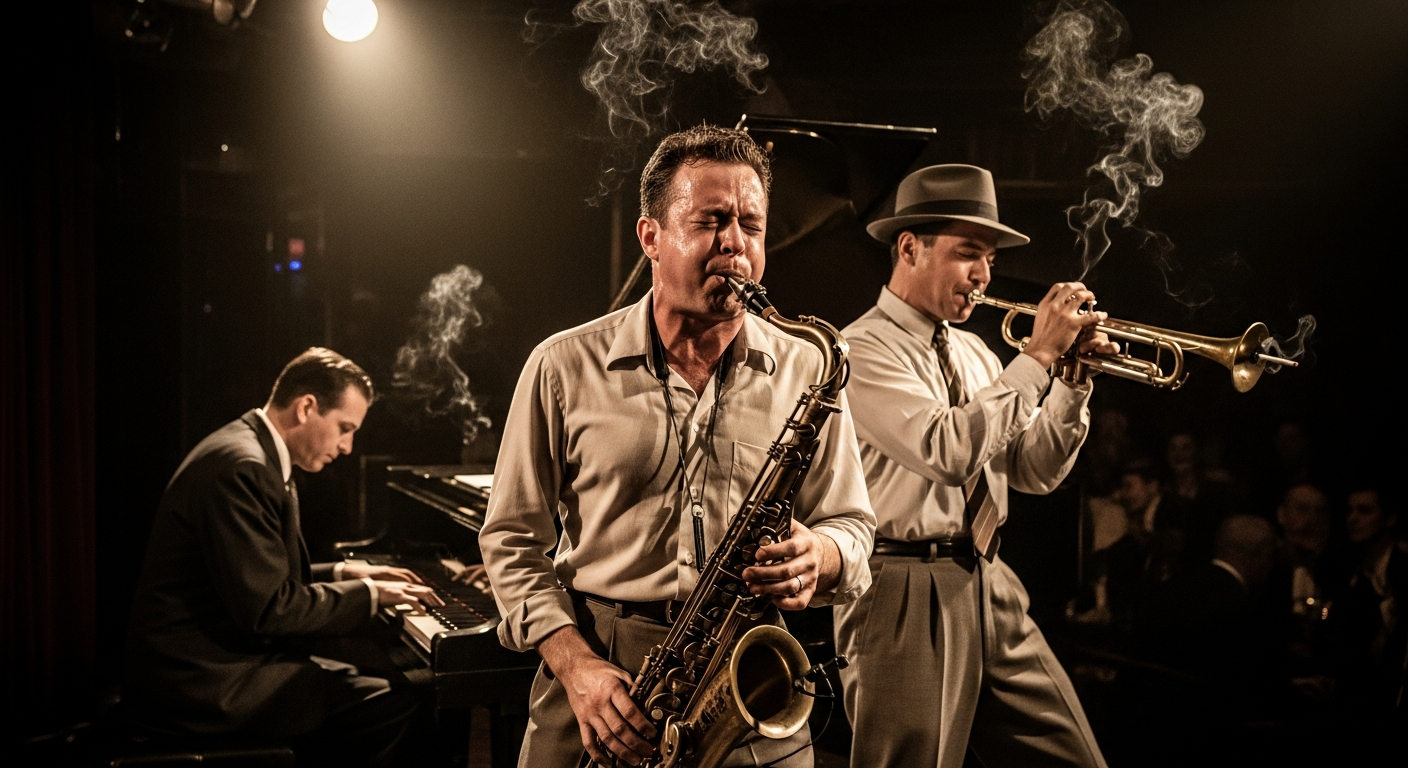
Jazz rhythm is more fluid and interactive. The standard jazz rhythm section (piano, bass, drums) engages in constant conversation — the drummer responds to the soloist, the pianist adjusts voicings based on what the bass plays, and the entire ensemble breathes together. Swing feel — the characteristic long-short rhythm of jazz eighth notes — is a defining element that blues does not typically use. Jazz also embraces irregular rhythmic patterns, polyrhythms, and metric modulation in ways that blues does not.
Improvisation: Feeling vs. Navigating
Both genres feature improvisation, but the approach is fundamentally different. Blues improvisation is melodic and vocal-inspired. A great blues solo tells a story: it builds tension through repetition, uses space and silence for dramatic effect, and resolves with the emotional weight of a sung lyric. The improviser is working within a limited harmonic framework and using that simplicity to go deep rather than wide.
Jazz improvisation is harmonic. The improviser must navigate a series of changing chords, choosing appropriate scales and melodic ideas for each harmonic moment. A jazz solo over 'All the Things You Are' requires the musician to think in four different key centres within 36 bars. The challenge is not just emotional expression — it is real-time harmonic problem-solving at speed.
Neither approach is superior. B.B. King could say more with three notes on a blues scale than some jazz musicians say in three choruses of Giant Steps. Expression and technique serve different but equally valid musical purposes.
Song Structure
Blues structure is remarkably consistent. The 12-bar blues is the dominant form: three four-bar phrases following an AAB lyric pattern ('I woke up this morning' / 'I said, I woke up this morning' / 'And my baby was gone'). This 12-bar cycle repeats for the entire song, with verses, solos, and the head all following the same progression.
Jazz uses a wider variety of forms. The most common is the 32-bar AABA form (used in standards like 'Take the A Train' and 'Satin Doll'), but jazz also uses ABAC forms, 16-bar forms, through-composed pieces, and free-form structures. And yes, jazz uses the 12-bar blues too — the jazz blues is one of the most important vehicles in the genre.
Where They Meet: The Jazz Blues
The jazz blues is where the two genres shake hands. A jazz blues takes the 12-bar blues form and enriches it with jazz harmony — adding ii-V-I progressions, tritone substitutions, and chromatic passing chords. Charlie Parker's 'Now's the Time' and 'Blues for Alice' are both 12-bar blues, but the harmonic sophistication of 'Blues for Alice' places it firmly in the jazz world.
Most jazz musicians consider the blues essential to their art. Miles Davis recorded blues throughout his career. John Coltrane's 'Blue Train' is a jazz masterpiece built on a blues framework. The blues is not something jazz left behind — it is something jazz carries within it at all times.
Summary: Key Differences at a Glance
- Harmony: Blues = 3 chords (I-IV-V), Jazz = complex extended harmony across multiple keys
- Scales: Blues = pentatonic/blues scale, Jazz = Dorian, Mixolydian, Altered, Bebop, and many more
- Rhythm: Blues = shuffle/groove, Jazz = swing feel with interactive rhythm section
- Improvisation: Blues = melodic, emotional, repetition-based; Jazz = harmonic, navigational, scale-based
- Structure: Blues = 12-bar form; Jazz = AABA, blues, and many other forms
- Expression: Blues = raw, direct, vocal; Jazz = sophisticated, complex, instrumental