In the early 1940s, a group of young musicians in Harlem decided that jazz was not challenging enough. The swing era had turned jazz into popular entertainment — big bands playing danceable arrangements for mass audiences. The music was good, but it was safe. Charlie Parker, Dizzy Gillespie, Thelonious Monk, and their collaborators wanted something dangerous.
What they created was bebop — faster, more harmonically complex, more rhythmically adventurous, and deliberately resistant to commercial appeal. Bebop was jazz's declaration of independence: the moment the music stopped being entertainment and became art.
Where It Started: Minton's Playhouse
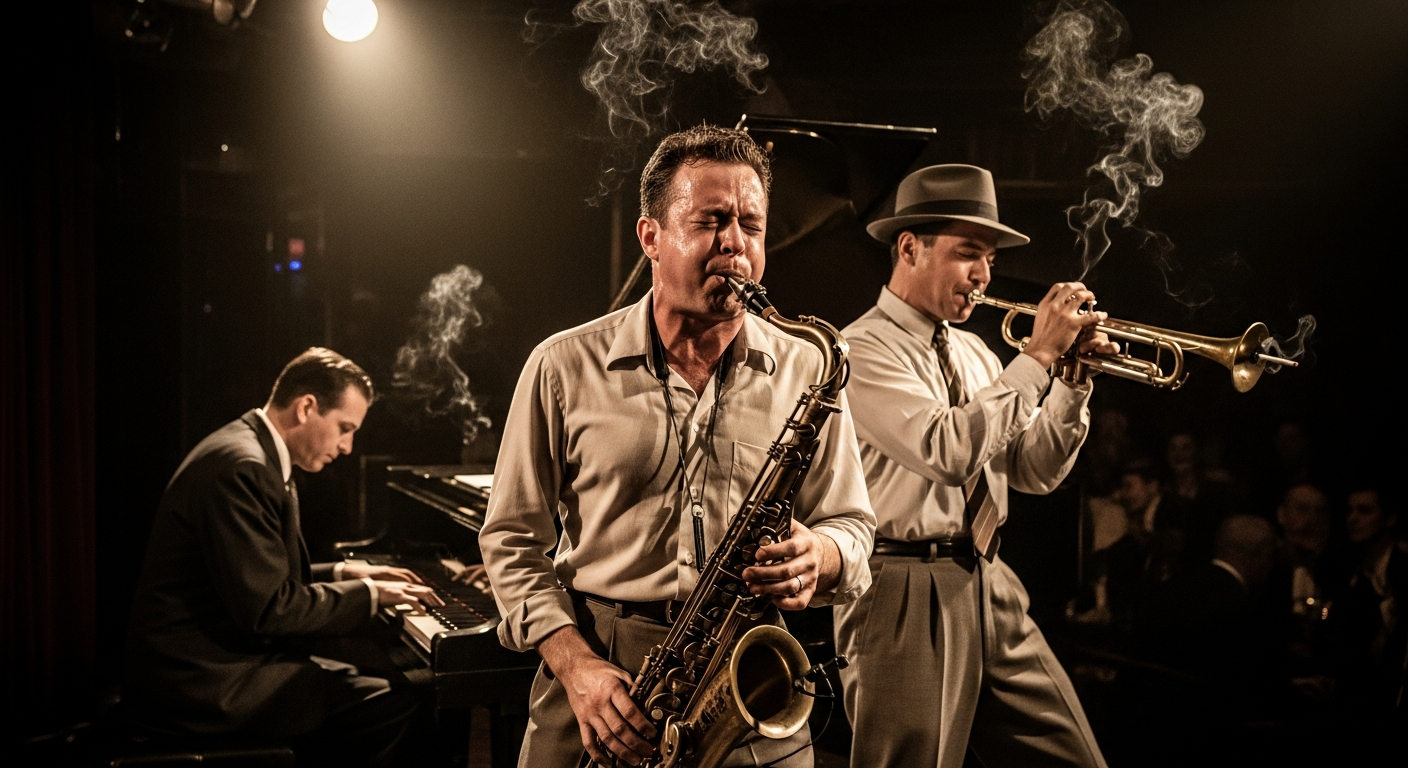
Bebop was not born in a recording studio. It was born at after-hours jam sessions — particularly at Minton's Playhouse and Monroe's Uptown House in Harlem. After finishing their regular gigs with swing bands, young musicians would gather at these clubs to play for each other, experimenting with faster tempos, more complex harmonies, and longer improvisations than their big-band employers would allow.
The sessions at Minton's were competitive. Musicians who could not keep up with the harmonic and technical demands were subtly — or not so subtly — encouraged to leave the bandstand. Parker and Gillespie would deliberately play in difficult keys and at extreme tempos to thin out the crowd. The music was forged in this crucible of mutual challenge and inspiration.
What Made Bebop Different
Bebop changed jazz in several fundamental ways:
Speed and Complexity
Swing-era tunes typically moved at comfortable dancing tempos (120–180 BPM). Bebop pushed tempos to 200, 250, even 320 BPM. At these speeds, only the most technically accomplished musicians could keep up. Parker's 'Ko-Ko' and 'Donna Lee' remain some of the most demanding pieces in the jazz repertoire.
Harmonic Sophistication
Bebop musicians enriched the harmony of jazz by adding chord extensions (9ths, 11ths, 13ths), altered tones (b9, #9, #11, b13), and chord substitutions — replacing one chord with another that shared certain key tones. The tritone substitution (replacing a dominant chord with another dominant chord a tritone away) became a bebop hallmark. Use our Chord Voicing Reference to explore the extended voicings that define the bebop sound.
Melodic Language
Bebop melodies are angular, asymmetric, and unpredictable. Where swing melodies were smooth and singable, bebop melodies are full of unexpected leaps, chromatic passing tones, and rhythmic displacement. Parker's melodic language — built on arpeggios, enclosures, and chromatic approach notes — became the foundation of modern jazz improvisation.
Rhythm Section Revolution
In swing, the drummer kept a steady beat for dancing. In bebop, the drummer became an interactive conversationalist. Kenny Clarke shifted the primary timekeeping from the bass drum to the ride cymbal, freeing the bass drum and snare for accents and responses to the soloists. This 'dropped bomb' technique transformed the drums from a timekeeper into a creative voice.
The Key Figures
Charlie Parker (1920–1955)
The genius of bebop. Parker's alto saxophone playing was so harmonically advanced and so blazingly fast that musicians who heard him for the first time could not believe what they were hearing. His improvisations contain an inexhaustible wealth of melodic ideas — transcribing and studying his solos remains the foundational education for every jazz improviser. He died at 34, destroyed by heroin addiction, but his music is immortal.
Dizzy Gillespie (1917–1993)
If Parker was bebop's poet, Gillespie was its architect. Dizzy's trumpet playing was technically dazzling, and his understanding of harmony was encyclopedic. He was also bebop's greatest ambassador — charming, funny, and tireless in promoting the music. He integrated Afro-Cuban rhythms into bebop, creating a synthesis that produced 'A Night in Tunisia,' 'Manteca,' and the entire Latin jazz movement.
Thelonious Monk (1917–1982)
Monk was bebop's most original mind. His piano playing was angular, percussive, and deliberately awkward — the opposite of the smooth virtuosity favoured by other pianists. His compositions ('Round Midnight,' 'Straight, No Chaser,' 'Epistrophy,' 'Blue Monk') are among the most distinctive in jazz, built on dissonance, space, and an unerring sense of rhythmic surprise.
Bud Powell (1924–1966)
Powell translated Charlie Parker's saxophone language to the piano. His right hand played bebop lines with the speed and fluency of a horn, while his left hand provided sparse, rhythmic chord accents. This approach — fast single-note lines in the right hand, minimal comping in the left — became the default style for jazz piano and remains so today.
Essential Bebop Recordings
- Charlie Parker — 'Ko-Ko' (1945): The recording that announced bebop to the world. Parker's solo is a tornado of ideas.
- Dizzy Gillespie — 'A Night in Tunisia' (1946): Afro-Cuban bebop at its most thrilling.
- Charlie Parker & Dizzy Gillespie — 'Shaw 'Nuff' (1945): The twin founders at their peak, playing in breathtaking unison.
- Thelonious Monk — 'Round Midnight' (1947): Monk's most famous ballad, hauntingly beautiful.
- Bud Powell — 'Tempus Fugit' (1949): Piano bebop at its most dazzling.
- Max Roach & Clifford Brown — 'Daahoud' (1954): Hard bop emerging from bebop's foundation.
Bebop's Legacy
Every style of jazz that followed — hard bop, cool jazz, modal jazz, free jazz, fusion — is built on bebop's foundation. The harmonic language Parker and Gillespie codified remains the standard vocabulary of jazz improvisation. The rhythmic innovations of Clarke and Roach are still how jazz drummers play. Monk's compositions are still performed nightly in jazz clubs worldwide.
Bebop was controversial in its time — critics called it noise, and swing-era musicians dismissed it as showing off. But it won. Today, 'learning to play jazz' essentially means 'learning bebop vocabulary.' It is the grammar of the language, and every jazz musician must speak it fluently.