The word 'swing' means two things in jazz, and both are essential. First, swing is a style of jazz — the big band era of the 1930s and 40s, when jazz was the most popular music in America, and dance halls from Harlem to Hollywood were packed every night. Second, swing is a rhythmic feel — the lilting, forward-leaning pulse that makes jazz sound like jazz, regardless of era or style.
Understanding swing in both senses is understanding the heart of jazz.
Swing as a Rhythmic Feel
In most Western music, eighth notes are played with equal length — each gets exactly half a beat. This is called 'straight' eighth notes, and it is how rock, pop, classical, and most other genres are played.
In jazz, eighth notes are played with a 'long-short' pattern. The first eighth note is held slightly longer, and the second is shortened, creating a lilting, bouncing feel. This is swing. It is subtle — you feel it more than you hear it — but it is the single most important element of jazz rhythm. Without swing, you can play all the right notes with all the right harmony and it will not sound like jazz.
The degree of swing varies by tempo and style. At slow tempos, swing is gentle and relaxed. At medium tempos, it is smooth and propulsive. At fast tempos, swing becomes more even (approaching straight eighths) because the notes are too fast to exaggerate the long-short pattern. This natural variation is one of the things that makes jazz rhythm feel organic rather than mechanical.
The Swing Era: When Jazz Ruled America
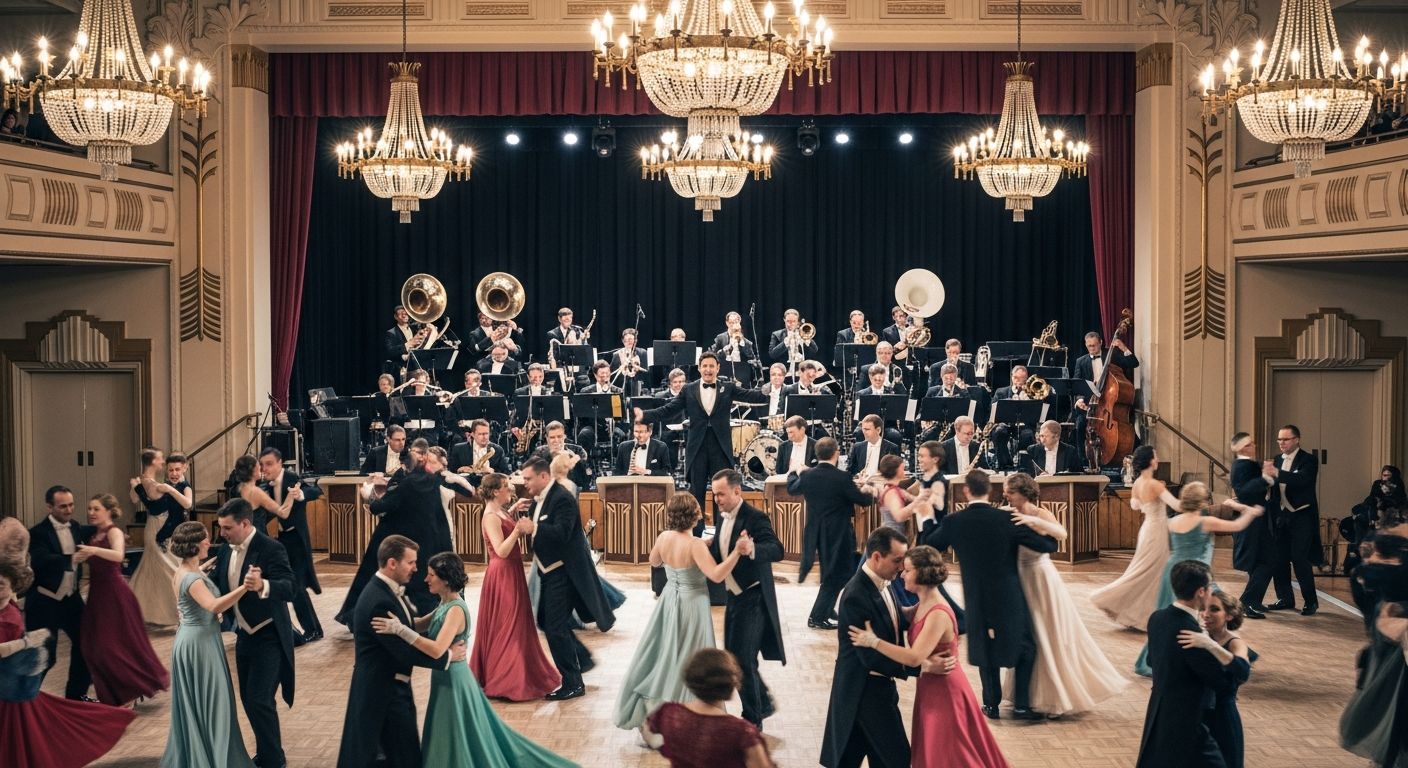
The Swing Era — roughly 1935 to 1945 — was the only time in history when jazz was the dominant form of popular music. Big bands with 15 to 20 musicians played for dancing audiences in ballrooms, hotels, and theatres across America. Jazz musicians were the pop stars of their day — Duke Ellington, Benny Goodman, and Glenn Miller were as famous as any entertainer in the country.
How It Began
Jazz big bands had existed since the 1920s (Fletcher Henderson, Duke Ellington), but the Swing Era is usually dated from Benny Goodman's breakthrough concert at the Palomar Ballroom in Los Angeles on August 21, 1935. Goodman's band played hot, driving arrangements for a young audience that went wild. The 'swing craze' was born, and within months, big bands were the biggest entertainment business in America.
The Big Three
Duke Ellington (1899–1974): The most important composer in jazz history. Ellington's orchestra was not just a dance band — it was a vehicle for artistic expression of the highest order. Pieces like 'Take the A Train,' 'It Don't Mean a Thing,' 'Satin Doll,' and his extended suites ('Black, Brown and Beige') elevated big band music to art music while remaining exhilarating to dance to.
Count Basie (1904–1984): Basie's orchestra was the most swinging band in jazz. His spare, bluesy piano style and his band's driving rhythm section (anchored by guitarist Freddie Green's relentless four-to-the-bar strumming) created an irresistible rhythmic engine. Basie's soloists — Lester Young, Herschel Evans, Buck Clayton — were among the greatest improvisers of the era.
Benny Goodman (1909–1986): The 'King of Swing' and the first bandleader to integrate his groups racially, hiring Teddy Wilson (piano) and Lionel Hampton (vibraphone) for his small groups. Goodman's clarinet playing was technically brilliant, and his band's arrangements (many by Fletcher Henderson) were exciting and polished.
The Dance Connection
Swing music and swing dance evolved together. The Lindy Hop — an energetic, improvisational partner dance — was born at the Savoy Ballroom in Harlem, where Chick Webb's orchestra played nightly. The dancers' athleticism and spontaneity pushed the musicians to play with more energy and rhythmic drive, and the music's intensity pushed the dancers to greater heights. This feedback loop between musicians and dancers is unique to the Swing Era and is one reason the music has such irresistible physical energy.
Why the Swing Era Ended
The Swing Era declined after World War II for several reasons. A wartime 20% entertainment tax on venues with dancing made big bands economically difficult to sustain. The American Federation of Musicians' recording ban (1942–44) disrupted the record industry. Vocalists like Frank Sinatra began outselling the bands they sang with, shifting the spotlight from the ensemble to the individual. And bebop — a small-group, non-dancing style created by Charlie Parker, Dizzy Gillespie, and their peers — split the jazz audience between those who wanted to dance and those who wanted to listen.
Big bands never disappeared — Ellington and Basie kept their orchestras going into the 1970s and 80s — but after 1945, jazz was no longer America's popular music. It became an art form for dedicated listeners.
Swing's Legacy
Swing rhythm did not die with the Swing Era. It is the foundation of virtually all jazz that followed — bebop, hard bop, cool jazz, and most modern jazz still swing. The big band format endures in jazz education (every university has a big band) and in professional ensembles like the Jazz at Lincoln Center Orchestra and the Maria Schneider Orchestra.
And swing dancing has experienced a remarkable revival. Lindy Hop communities exist in cities worldwide, dancing to the same Count Basie and Chick Webb recordings that filled the Savoy Ballroom 90 years ago. The music's joy, energy, and irresistible rhythm are truly timeless.