There is a paradox at the heart of jazz practice: the musicians who sound the most effortless at high tempos are the ones who spent the most time practising at low tempos. Speed in jazz is not achieved by playing fast — it is achieved by playing correctly, slowly, until the correct movements become automatic. Then you gradually increase the tempo, and the speed takes care of itself.
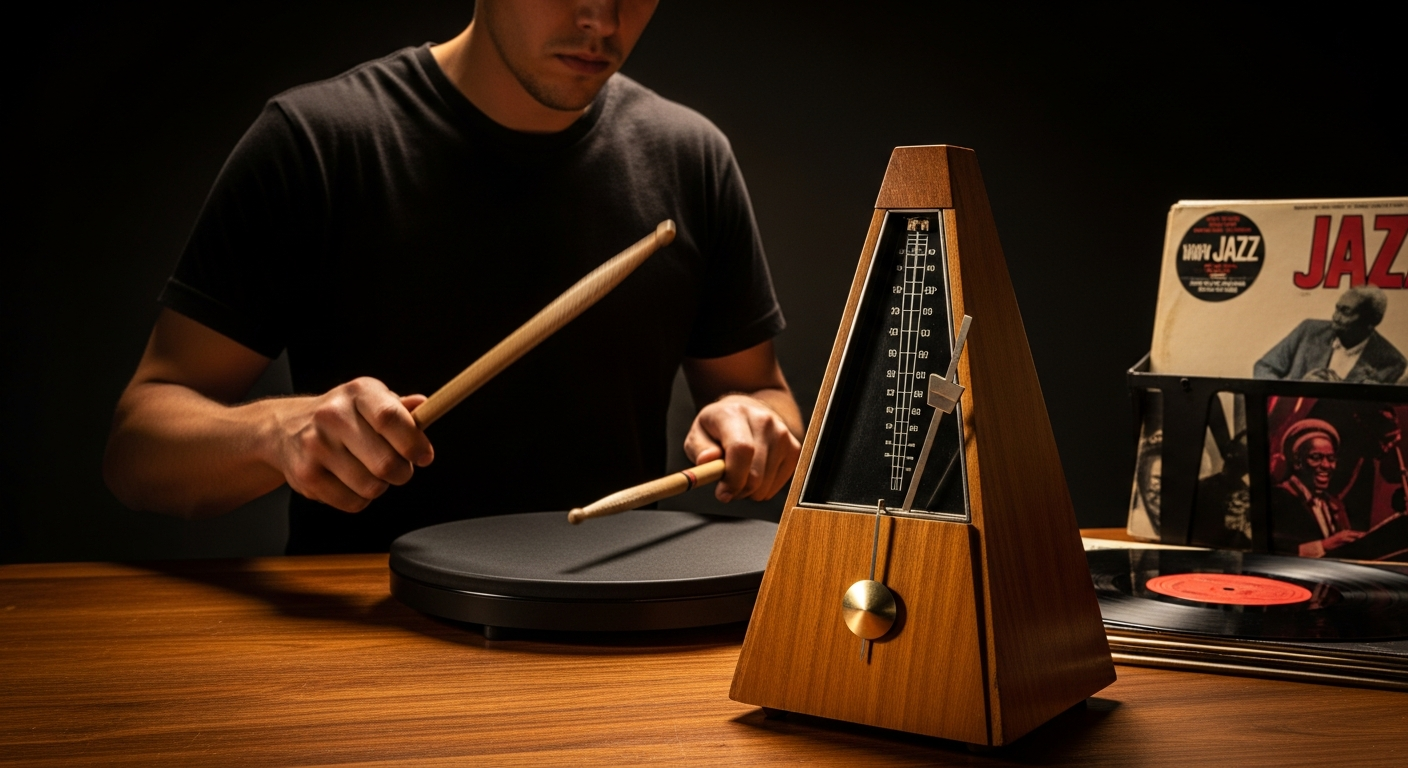
The metronome is the tool that makes this process possible. And yet many jazz students resist using one, viewing it as a mechanical crutch that kills musical feeling. The opposite is true. A metronome frees you to focus on expression by taking the cognitive burden of timekeeping off your shoulders. Every great jazz musician — from Charlie Parker to Brad Mehldau — practised with a metronome.
To find the tempo of any recording you want to learn, use our free BPM Tap Tool. Tap along with the recording, and the tool will give you the exact tempo. Then set your metronome slower — at least 20% slower — and begin your practice there.
Finding Your Practice Tempo
The ideal practice tempo is the speed at which you can play the material with:
- No wrong notes
- Relaxed hands and body (no tension in the shoulders, arms, or fingers)
- Consistent rhythm (every note placed precisely in time)
- Good tone quality (not sacrificing sound for speed)
For most musicians working on new material — a new scale, a new set of voicings, a new tune — this tempo is somewhere between 60 and 80 BPM. That may feel painfully slow, but slow practice is where technique is built. Once you can play the material perfectly at 60 BPM, increase to 65. Then 70. Then 75. This 5-BPM-at-a-time approach is the method used by virtually every conservatory in the world, because it works.
The Metronome on 2 and 4
In classical music, the metronome clicks on every beat (1-2-3-4) or on beats 1 and 3 (the strong beats). In jazz, the standard practice is to set the metronome on beats 2 and 4 — the backbeats. This simulates the hi-hat pattern of a jazz drummer and develops the forward-leaning rhythmic feel that defines swing.
To practise with the metronome on 2 and 4, set it to half the tempo you want. If your target is 120 BPM, set the metronome to 60 BPM and feel each click as beat 2 or beat 4. At first, this is disorienting — your brain will want to put the click on beat 1. Persist. Within a few sessions, the 2-and-4 feel will become natural, and your time feel will improve dramatically.
Tempo Ranges in Jazz
Different jazz styles operate in different tempo ranges. Knowing these ranges helps you set appropriate practice targets and understand the physical demands of the music:
- Ballad: 60–80 BPM — slow, lyrical playing that demands control and expression
- Medium swing: 120–160 BPM — the comfortable cruising speed of most jazz standards
- Up-tempo swing: 200–280 BPM — exciting, demanding, requires fluent technique
- Bossa nova: 120–145 BPM — relaxed, even eighth notes, Brazilian feel
- Latin jazz: 100–130 BPM — clave-based rhythms, Afro-Cuban influence
- Jazz waltz: 120–180 BPM — three-beat feel, lighter swing
- Bebop: 180–320 BPM — the extreme end, requiring years of practice
Use our BPM Tap Tool to tap along with your favourite recordings and discover their tempos. You may be surprised — tunes that sound blazingly fast are often slower than you think, and tunes that feel relaxed are often faster than you expect.
Building a Tempo-Based Practice Routine
Here is a practical framework for using tempo in your daily practice:
- Warm up (5 min): Scales and arpeggios at 60–72 BPM, focus on tone and relaxation
- New material (15 min): Whatever you are currently learning — new voicings, new scales, new tunes — at the slowest tempo where you can play it correctly. Use our Chord Voicing Reference and Scale Finder for reference.
- Familiar material (15 min): ii-V-I progressions, tunes you already know, at gradually increasing tempos. Use our ii-V-I Generator for the chord symbols.
- Performance tempo (10 min): Play a tune at or near performance tempo, focusing on musicality and expression rather than perfection
- Cool down (5 min): Free improvisation at a comfortable tempo, no pressure, just playing for the joy of it
The most important principle is consistency. Thirty minutes of focused, metronome-guided practice every day will develop your playing faster than three hours of unfocused noodling. The metronome keeps you honest, the tempo keeps you progressive, and the structure keeps you efficient.