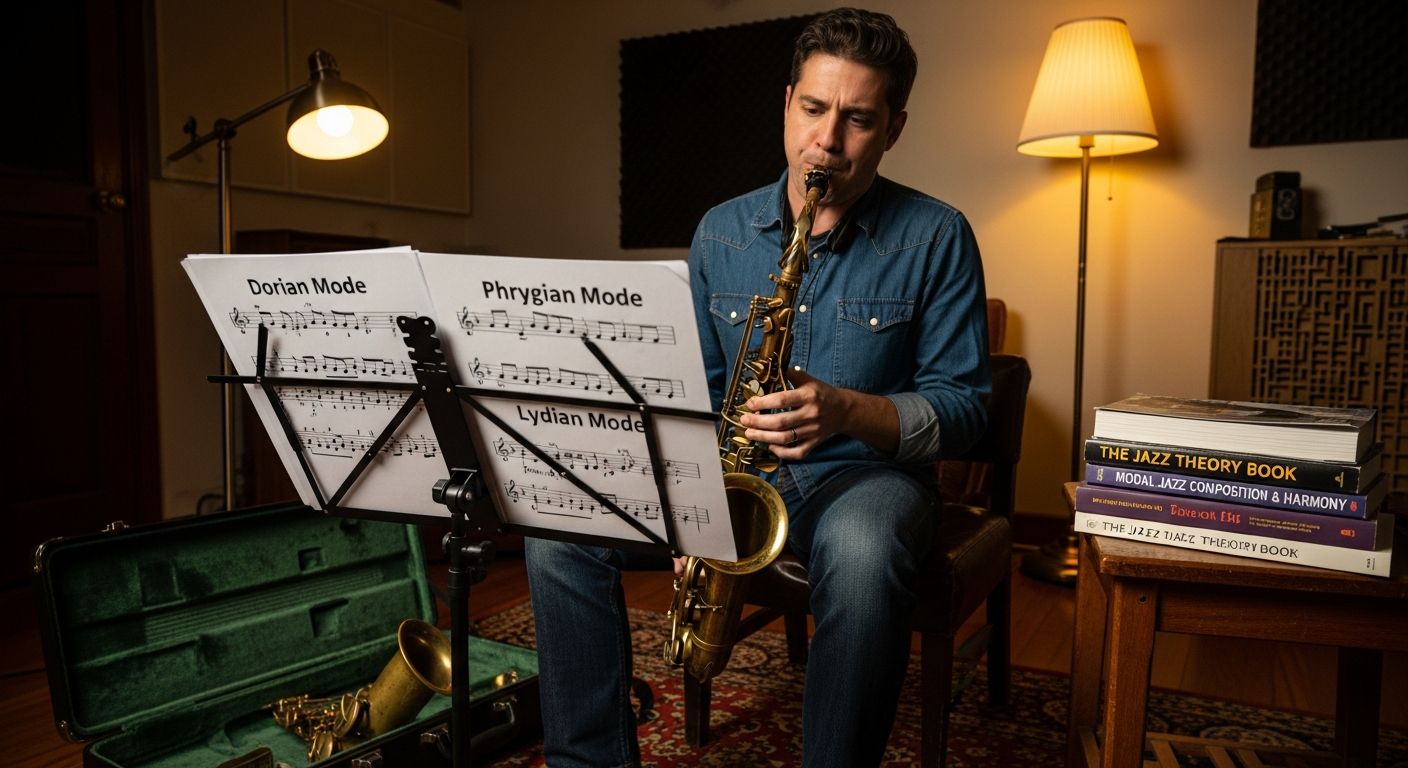
Ask a hundred jazz musicians how they learned to improvise, and you will get a hundred different answers — but nearly all of them will mention scales at some point. Scales are not the destination of jazz improvisation (that would be melody, rhythm, and storytelling), but they are the map. Knowing which notes are available over a given chord is the prerequisite for choosing the right ones.
The good news is that you do not need to memorise hundreds of exotic scales. Ten scales cover roughly 95% of the harmonic situations you will encounter in the standard jazz repertoire. Here they are, in the order you should learn them.
As you work through this guide, use our free Jazz Scale Finder tool to see which scales fit over any chord type, complete with interactive piano keyboard diagrams and practical explanations of when each scale works best.
1. Dorian Mode
Formula: 1 – 2 – b3 – 4 – 5 – 6 – b7
Use over: Minor 7th chords (ii chord in a major key)
Dorian is the workhorse of jazz improvisation. It differs from the natural minor (Aeolian) by one note — the raised 6th — which gives it a brighter, less melancholy quality. When you see Dm7 in a ii-V-I progression, Dorian is the default choice. Miles Davis's 'So What' is built entirely on Dorian, making it the perfect study piece.
2. Mixolydian Mode
Formula: 1 – 2 – 3 – 4 – 5 – 6 – b7
Use over: Dominant 7th chords (V chord, static dominants)
Mixolydian is the major scale with a flatted 7th. It is the natural, consonant scale for any dominant 7th chord and produces a bluesy, soulful sound. When you are playing over a G7 chord and do not want to add tension, Mixolydian is the safe, effective choice.
3. Ionian Mode (Major Scale)
Formula: 1 – 2 – 3 – 4 – 5 – 6 – 7
Use over: Major 7th chords (I chord)
The familiar major scale. It works perfectly well over Imaj7 chords, though many jazz musicians prefer Lydian (see below) to avoid the slight tension between the natural 4th and the major 3rd. Use Ionian when you want a warm, resolved, 'coming home' sound.
4. Lydian Mode
Formula: 1 – 2 – 3 – #4 – 5 – 6 – 7
Use over: Major 7th chords (especially IVmaj7)
Lydian raises the 4th degree by a half step, eliminating the one potentially clashing note in the major scale. The result is an open, floating, dreamy quality that became the hallmark of Bill Evans, Pat Metheny, and much of the ECM Records aesthetic. Many jazz musicians default to Lydian over any major 7th chord.
5. Altered Scale (Super Locrian)
Formula: 1 – b9 – #9 – 3 – b5 – #5 – b7
Use over: Dominant 7th chords resolving to I (V7alt)
The Altered scale is the seventh mode of the melodic minor scale, and it is the single most powerful tension-creating device in jazz. Every extension is altered — the 9th is both flatted and sharped, and the 5th is both flatted and sharped — producing maximum dissonance that resolves beautifully when the chord moves to the tonic. If you learn only one 'advanced' scale, make it this one.
6. Bebop Dominant Scale
Formula: 1 – 2 – 3 – 4 – 5 – 6 – b7 – 7
Use over: Dominant 7th chords (in eighth-note lines)
The Bebop Dominant scale adds a chromatic passing tone (the natural 7th) to the Mixolydian mode, creating an eight-note scale. The genius of this addition is mathematical: with eight notes instead of seven, chord tones align perfectly with strong beats when playing continuous eighth notes. This is the secret behind the effortless swing of Charlie Parker, Dizzy Gillespie, and every bebop player since.
7. Blues Scale
Formula: 1 – b3 – 4 – b5 – 5 – b7
Use over: Blues progressions, dominant chords, minor chords
The blues scale is a minor pentatonic with an added b5 (the 'blue note'). It is the most versatile scale in American music — it works over virtually any chord in a blues context and adds an earthy, vocal quality to jazz improvisation. Charlie Parker used it constantly, and so should you.
8. Whole Tone Scale
Formula: 1 – 2 – 3 – #4 – #5 – b7
Use over: Augmented chords, dominant 7#5
The whole tone scale divides the octave into six equal whole steps, creating a floating, ambiguous sound with no sense of resolution. Thelonious Monk and Wayne Shorter used it to create moments of harmonic suspension. It works well over augmented chords and dominant chords where you want a dreamy, unresolved quality.
9. Diminished Scale (Half-Whole)
Formula: 1 – b2 – #2 – 3 – #4 – 5 – 6 – b7
Use over: Dominant 7th chords (for tension), diminished passing chords
The half-whole diminished scale alternates half steps and whole steps, creating a symmetric eight-note scale with a dark, angular quality. It is the scale of choice for dominant 7th chords where you want sophisticated tension without going fully 'altered.' John Coltrane and McCoy Tyner used it extensively.
10. Minor Pentatonic
Formula: 1 – b3 – 4 – 5 – b7
Use over: Minor chords, blues, modal jazz
The minor pentatonic is the simplest and most universally applicable scale in music. Its five notes are all strong chord tones or consonances, making it impossible to sound 'wrong.' It is the safety net of jazz improvisation — when you are lost over a chord change, the minor pentatonic built on the root will always work. John Coltrane's 'Impressions' and countless modal jazz tunes are built on minor pentatonic ideas.
How to Practise These Scales
Start with our Jazz Scale Finder — select any chord type to see which scales fit, with the notes highlighted on a piano keyboard in every key. Then practise each scale through ii-V-I progressions (use our ii-V-I Generator for the chord symbols) at a comfortable tempo (set yours with our BPM Tap Tool).
The goal is not to play scales up and down mindlessly. The goal is to hear each scale's colour — the brightness of Lydian, the tension of Altered, the earthiness of Blues — and to call upon that colour instinctively when the musical moment demands it.