If you hang around jazz musicians long enough, you will hear the word 'standard' constantly. 'Let's play a standard.' 'Do you know any standards in Bb?' 'I've been working on some new standards.' But what exactly is a jazz standard? Who decides which songs qualify? And why does it matter?
Definition
A jazz standard is a musical composition that has been widely adopted by the jazz community as part of the shared repertoire. It is a song that jazz musicians across generations, geographies, and styles know, play, and reinterpret. When a jazz musician at a jam session in Tokyo calls 'Autumn Leaves,' everyone on the bandstand knows the melody, the form, and the chord changes — just as a musician in New York, London, or São Paulo would.
The key word is shared. Standards are the common language of jazz. They allow musicians who have never met to play together without rehearsal, because everyone knows the same tunes.
Where Do Standards Come From?
Most jazz standards were not originally written as jazz. They come from four main sources:
Broadway Musicals
The largest source of jazz standards. Songs like 'All the Things You Are' (Jerome Kern, from Very Warm for May), 'My Funny Valentine' (Rodgers & Hart, from Babes in Arms), and 'Summertime' (Gershwin, from Porgy and Bess) were written for the theatre and adopted by jazz musicians because of their strong melodies and rich harmonies.
Tin Pan Alley and Popular Song
The popular songwriters of the early 20th century — Cole Porter, Irving Berlin, George Gershwin, Harold Arlen — produced songs that were both commercially successful and harmonically sophisticated enough to reward jazz improvisation. 'Night and Day,' 'Cheek to Cheek,' 'The Man I Love,' and 'Over the Rainbow' are all Tin Pan Alley songs that became jazz staples.
Jazz Compositions
Many standards were written by jazz musicians themselves. Thelonious Monk ('Round Midnight,' 'Straight, No Chaser'), Charlie Parker ('Now's the Time,' 'Confirmation'), Wayne Shorter ('Footprints,' 'Speak No Evil'), and Herbie Hancock ('Cantaloupe Island,' 'Maiden Voyage') all contributed compositions that became standards through the sheer force of their musical quality.
Film and Television
Hollywood produced standards like 'The Way You Look Tonight' (Jerome Kern), 'Moon River' (Henry Mancini), and 'As Time Goes By' (Herman Hupfeld, from Casablanca). These songs reached wide audiences through film and were subsequently adopted by jazz musicians.
The 20 Most Essential Jazz Standards
- 'Autumn Leaves' — The most commonly called standard at jam sessions. Learn this first. Use our ii-V-I Generator to practise the changes.
- 'All the Things You Are' — The most perfectly constructed jazz standard, with changes that move through four key centres.
- 'Summertime' — Gershwin's aria, simple and beautiful, open to infinite interpretation.
- 'My Funny Valentine' — A tender ballad with a descending chromatic bass line that never fails to move.
- 'Blue Bossa' — A Latin jazz standard by Kenny Dorham, accessible and groove-based.
- 'Take the A Train' — Ellington's signature, upbeat and iconic.
- 'Fly Me to the Moon' — A walking bass classic, universally known.
- 'So What' — Modal simplicity, infinite possibility.
- 'Round Midnight' — Monk's haunting masterpiece.
- 'Body and Soul' — The ultimate ballad for improvisers.
- 'Stella by Starlight' — Rich, romantic changes from a 1944 film.
- 'There Will Never Be Another You' — Clean ii-V-I progressions, lyrical melody.
- 'Night and Day' — Cole Porter's sophisticated masterwork.
- 'Satin Doll' — Ellington elegance, perfect ii-V comping practice.
- 'I Got Rhythm' — The second most important chord progression in jazz (after the blues).
- 'On Green Dolphin Street' — Major-minor alternation, beautiful bridge.
- 'Misty' — Erroll Garner's gorgeous ballad.
- 'In a Sentimental Mood' — Ellington at his most romantic.
- 'Softly, as in a Morning Sunrise' — A minor-key standard with dramatic power.
- 'Cantaloupe Island' — Hancock's funky gateway to jazz.
The Real Book
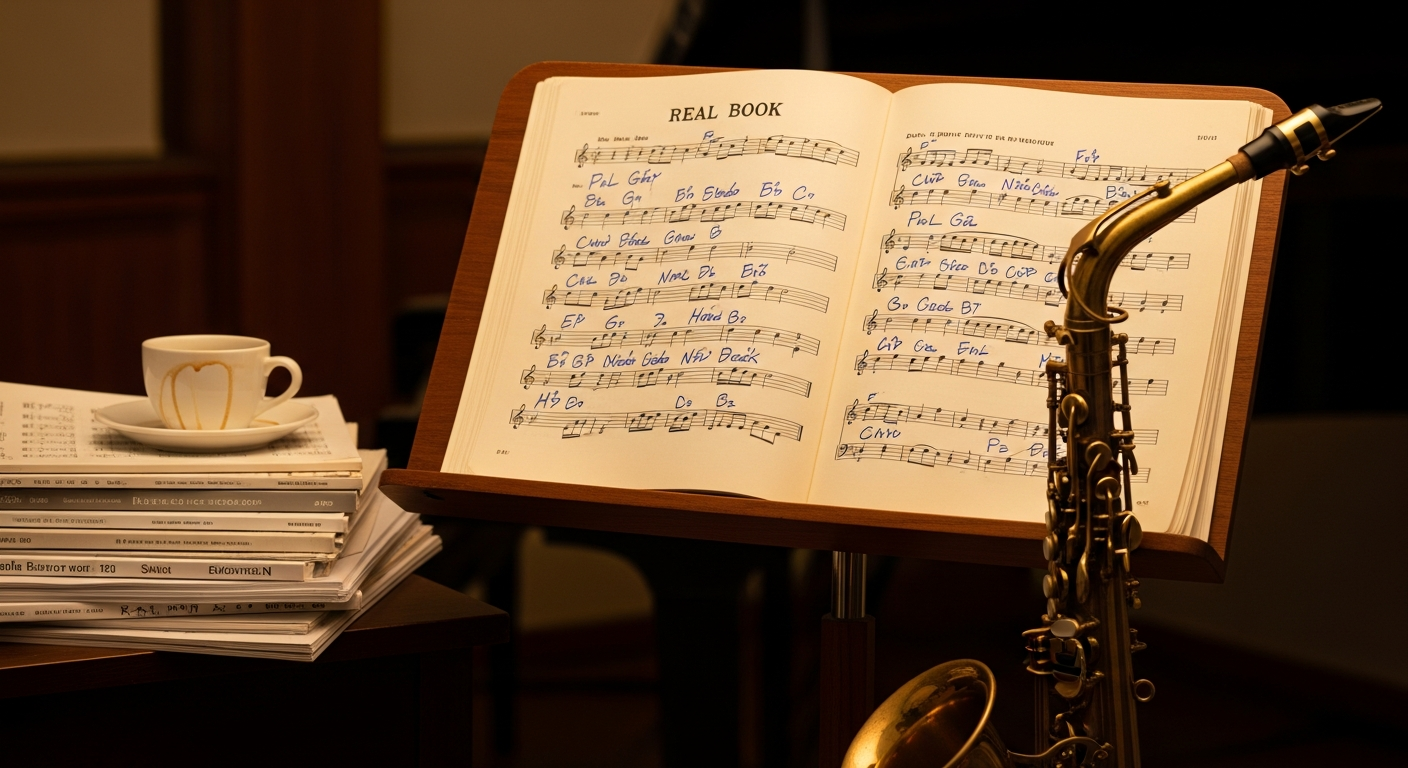
The Real Book is the closest thing jazz has to a canonical songbook. Originally compiled in the mid-1970s by students at Berklee College of Music, it was an illegal (copyright-infringing) collection of lead sheets that was photocopied and distributed through an underground network. Despite its illegality, it became the standard reference for every jazz musician — you could find a copy in every practice room, every gig bag, and every jazz club in America.
A legal version, published by Hal Leonard, appeared in 2004 and includes over 400 tunes. It remains the most widely used reference for jazz standards.
Why Standards Matter
Standards are not nostalgia. They are a living tradition. When a young musician learns 'Autumn Leaves,' they are not merely preserving a museum piece — they are entering a conversation that stretches back decades. Every musician who has played 'Autumn Leaves' has added something to it: a new voicing, a different rhythmic approach, a surprising substitution. The song grows richer with each new interpretation.
Standards also provide the common ground that makes jazz's spontaneous, improvised nature possible. Without a shared repertoire, jazz musicians could not sit in with strangers, form pickup bands, or participate in jam sessions. Standards are the language that holds the jazz community together.