If you put a classical pianist and a jazz pianist in front of the same grand piano, they will produce music so different that a listener might wonder if they are playing the same instrument. The classical pianist will read from a detailed score, reproducing every note exactly as the composer intended. The jazz pianist will glance at a chord chart showing nothing more than chord symbols, and invent the rest in real time. Same piano, same 88 keys, utterly different approaches to music-making.
This guide breaks down the key differences between jazz and classical music — not to declare one superior, but to help listeners and musicians understand what makes each tradition unique.
Improvisation vs Composition
The most fundamental difference. In classical music, the composer writes everything: every note, every dynamic, every articulation. The performer's job is to interpret and execute the score as faithfully and expressively as possible. A pianist performing Beethoven's 'Moonlight Sonata' plays the same notes as every other pianist — the artistry lies in the nuances of tempo, touch, phrasing, and emotional interpretation.
In jazz, the composer provides a framework — typically a melody and a set of chord changes — and the performer improvises within (and sometimes beyond) that framework. A jazz musician playing 'Autumn Leaves' will state the melody once, then improvise new melodies over the same chord changes for several choruses. No two performances are the same. The artistry lies in the spontaneous creation of music in real time.
This does not mean jazz is 'making it up' or that classical is 'just reading notes.' Both approaches require deep skill. But the skills are different: classical demands interpretive depth; jazz demands creative spontaneity.
Rhythm: Straight vs Swing
Classical rhythm is typically 'straight' — eighth notes are even, rhythms are precise, and the beat is metrically consistent. The conductor ensures that every member of the orchestra plays in exact rhythmic unison. Rubato (tempo flexibility) exists in classical music, but it is usually subtle and carefully controlled.
Jazz rhythm is built on swing feel — a lilting, triplet-based rhythm where the first eighth note is longer than the second, creating a forward-leaning, bouncing sensation. Jazz musicians also use extensive syncopation (accenting off-beats), and the rhythm section engages in constant conversation rather than playing a fixed pattern. The drummer responds to the soloist; the bassist adjusts to the piano; time is felt collectively rather than dictated by a conductor.
To experience the difference, try tapping along with a classical recording and then a jazz recording. You will feel the difference in your body before your mind analyses it.
Harmony: Rules vs Freedom
Classical harmony follows a tradition of rules developed over centuries — voice leading principles, counterpoint rules, functional harmony, and carefully controlled dissonance-resolution patterns. These rules produce the characteristic beauty and logic of classical music, from Bach's fugues to Debussy's impressionism.
Jazz harmony is built on breaking those rules. Jazz chords routinely include extended tones (9ths, 11ths, 13ths) that classical harmony would consider dissonant. Jazz voice leading allows parallel motion that classical counterpoint prohibits. Tritone substitutions, altered dominants, and chromatic passing chords create harmonic colours that have no equivalent in classical practice.
Explore the richness of jazz harmony with our Chord Voicing Reference — the extended and altered voicings you will see are distinctly jazz. Classical music would voice the same chords very differently.
Notation: Full Score vs Lead Sheet
A classical score is a complete document. It specifies every note, every rhythm, every dynamic marking, and often includes detailed performance instructions (tempo, articulation, pedalling). A full orchestral score might run to hundreds of pages. The performer's job is to realise this score as accurately and expressively as possible.
A jazz lead sheet is a single page. It shows the melody on one staff with chord symbols written above. That is it. The musician is responsible for choosing voicings, creating accompaniment patterns, deciding on rhythmic interpretation, and — most importantly — improvising solos. A jazz lead sheet is a map; a classical score is turn-by-turn directions.
Tone and Sound
Classical musicians are trained to produce a standardised 'beautiful' tone on their instrument. There is a widely agreed-upon ideal sound for a classical violin, a classical flute, or a classical tenor voice. Teachers spend years helping students achieve this ideal.
Jazz musicians cultivate a personal tone. Miles Davis's muted trumpet sounds nothing like Dizzy Gillespie's bright, brassy trumpet — and both are considered great. Thelonious Monk's angular, percussive piano touch would be considered a flaw in a classical context but is essential to his artistry. Jazz values individuality of sound; classical values conformity to an ideal.
Performance Context
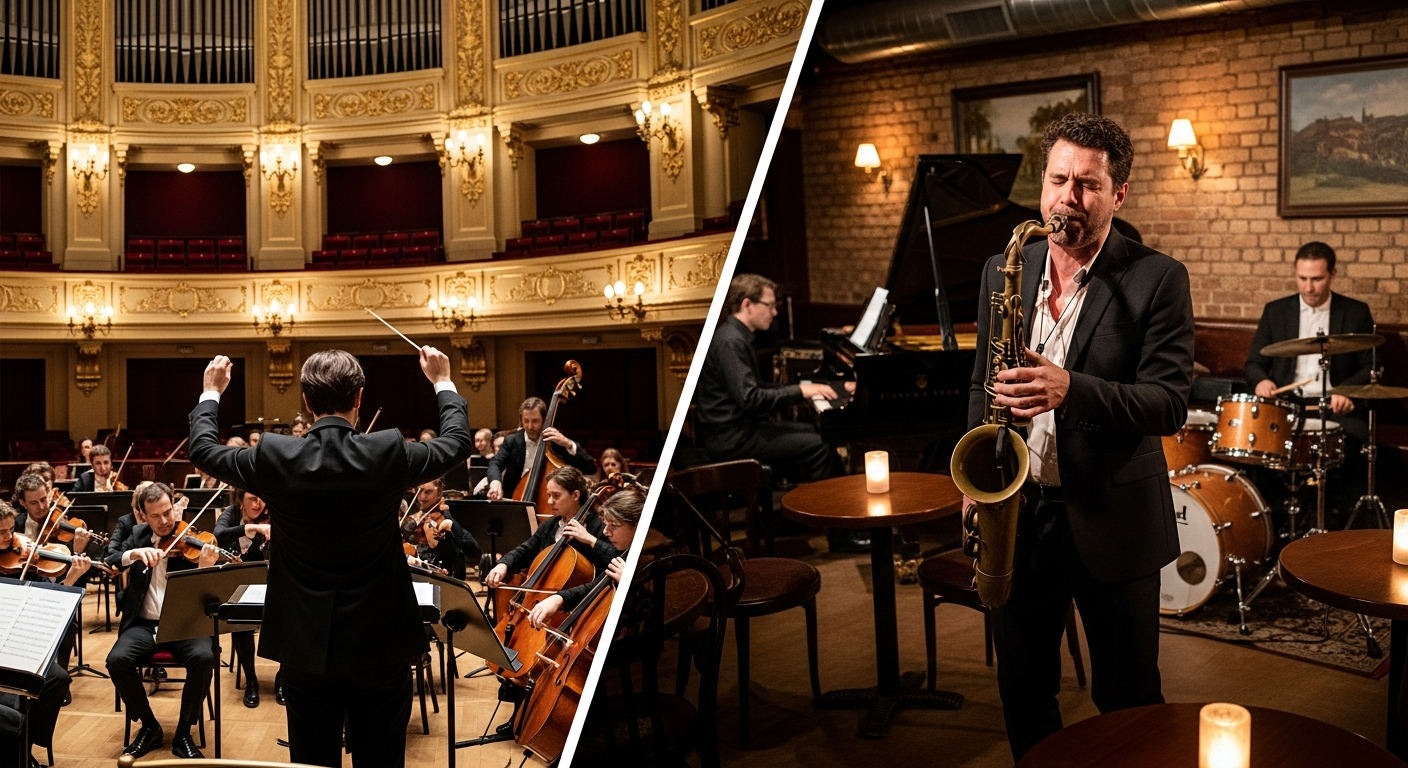
Classical music is typically performed in concert halls, with the audience seated silently, applauding only between movements (or at the end of a piece). The performer is elevated on a stage, physically separated from the audience. The experience is contemplative and formal.
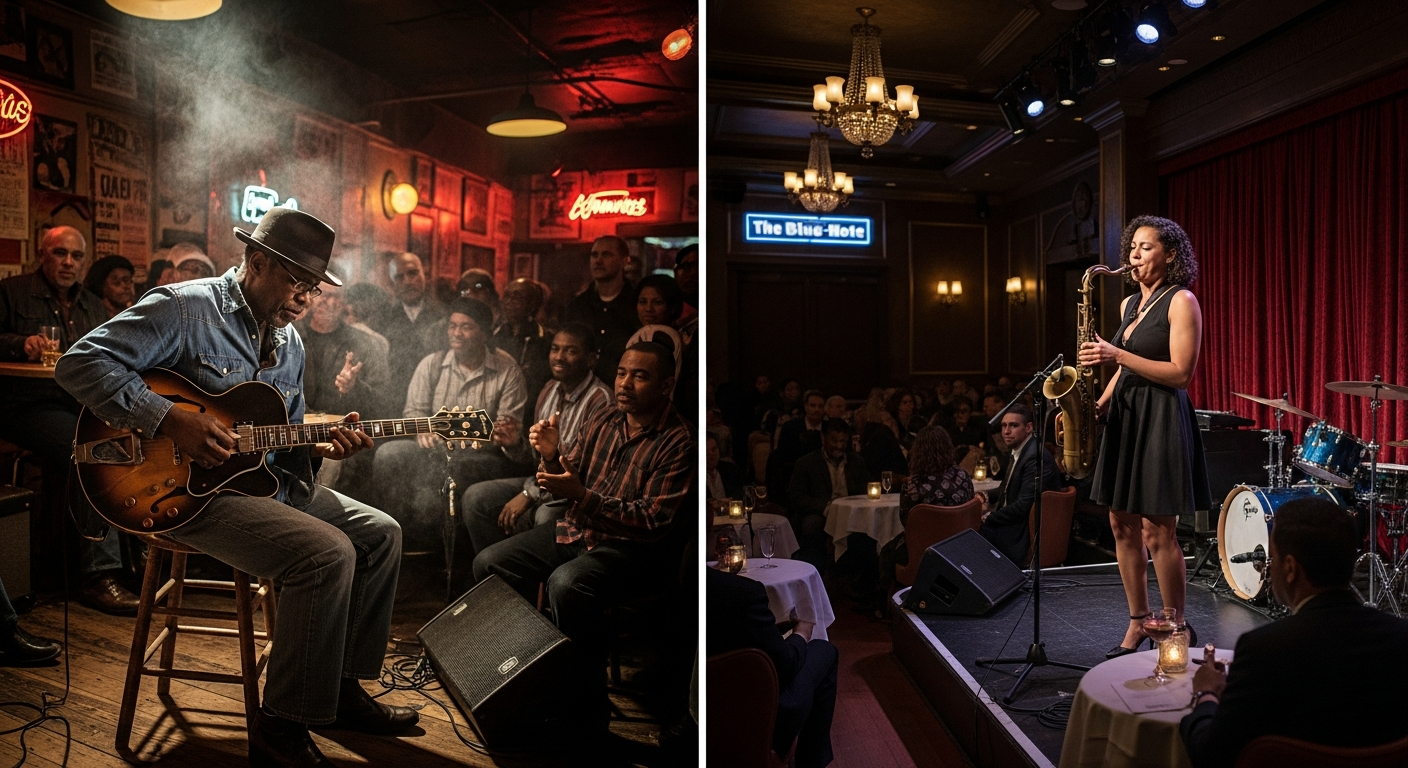
Jazz is typically performed in clubs, bars, and intimate venues, with the audience close to the musicians. Audience response — applause after solos, verbal encouragement, even conversation — is part of the experience. The atmosphere is social and interactive. The musician feeds off the audience's energy, and the audience participates in the music-making in a way that would be inappropriate in a concert hall.
Training and Education
Classical training emphasises technique, sight-reading, repertoire, and interpretive skills. Students spend years mastering scales, études, and repertoire pieces, working toward faithful reproduction of the written score. Examinations test accuracy and musicality.
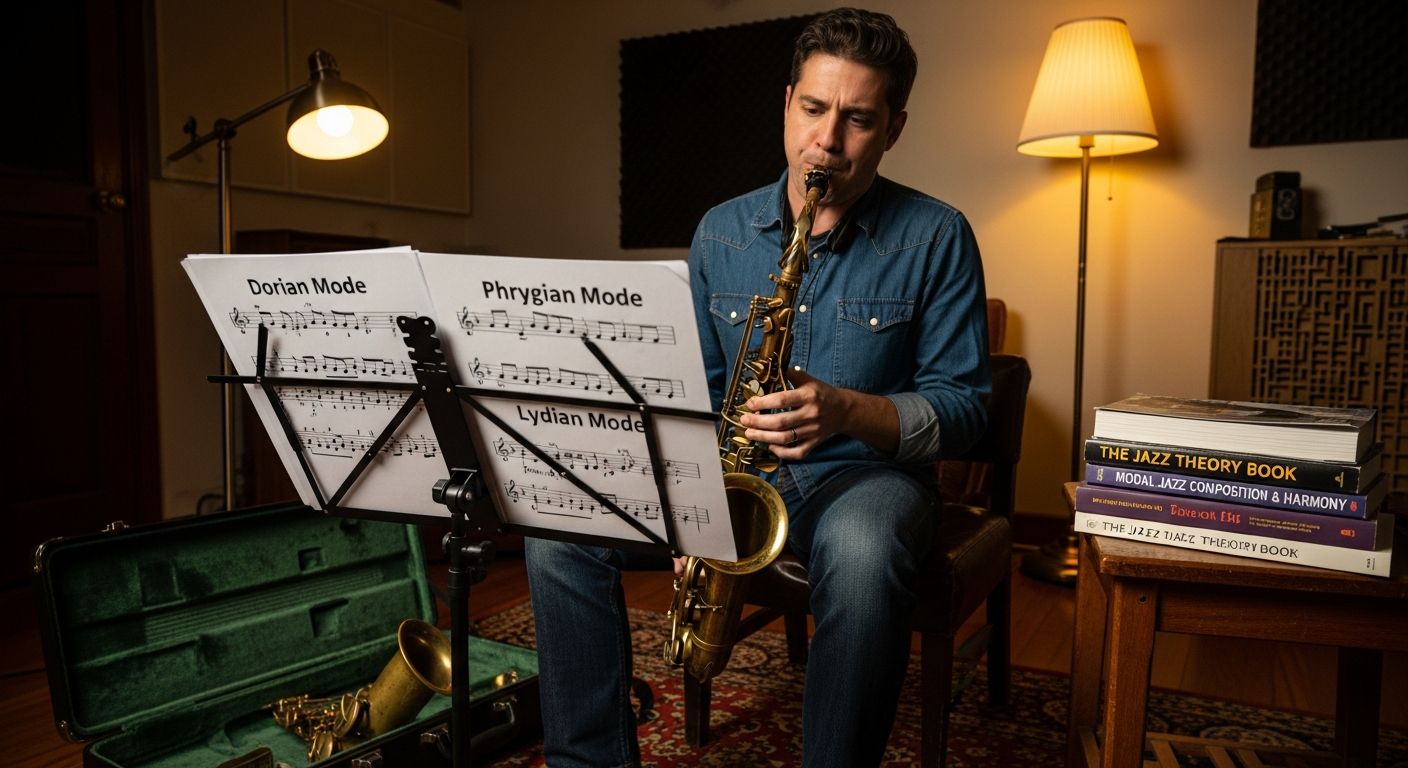
Jazz training emphasises ear training, harmonic theory, improvisation, and ensemble interaction. Students learn scales and modes (use our Scale Finder to explore them), practise ii-V-I progressions in every key (try our ii-V-I Generator), transcribe solos by ear, and develop their improvisational vocabulary through hours of playing over chord changes.
Both paths are rigorous and demanding. Neither is a shortcut. The difference is what they are training for: one trains you to interpret the written word; the other trains you to speak spontaneously.
Where They Meet
The boundary between jazz and classical has always been porous. George Gershwin's 'Rhapsody in Blue' blends classical orchestration with jazz harmony and blues feeling. Duke Ellington's orchestral suites brought jazz composition to symphonic scale. Third Stream music (a term coined by Gunther Schuller in the 1950s) deliberately fused both traditions.
Today, musicians like Esperanza Spalding, Vijay Iyer, and Brad Mehldau move freely between jazz and classical contexts. The traditions are not enemies — they are different languages for expressing the same human need for beauty, complexity, and emotional truth through sound.